Brazil's Green Coast: Diving Among Paradise Islands
Rio de Janeiro → Angra dos Reis → Ilha Grande → Barra de Tijuca
Intro: Christmas in Brazil
December 2025 brought me to Brazil’s Costa Verde, a stretch of coastline dotted with hundreds of islands where emerald waters meet dense Atlantic rainforest. What better way to spend Christmas week with family than exploring the islands and underwater world around Angra dos Reis and Ilha Grande?
 Snorkeling in the crystal-clear waters of Ilha Grande
From the bustling beaches of Rio de Janeiro to the tranquil coves of Ilha Grande, this journey was defined by two things: the relentless Brazilian summer sun (which at times I found absolutely scorching) and the incredible marine life that awaited beneath the surface. Over the course of a week, I would encounter seahorses, sea stars, colorful corals, and creatures I’d never seen before!
 View from Laguna Azul (Blue Lagoon) in Ilha Grande
In this post, I will outline our trip itinerary, drop a few tips, and show a photo guide of marine life that I collected after several days of snorkeling and diving.
[content_table]
Itinerary
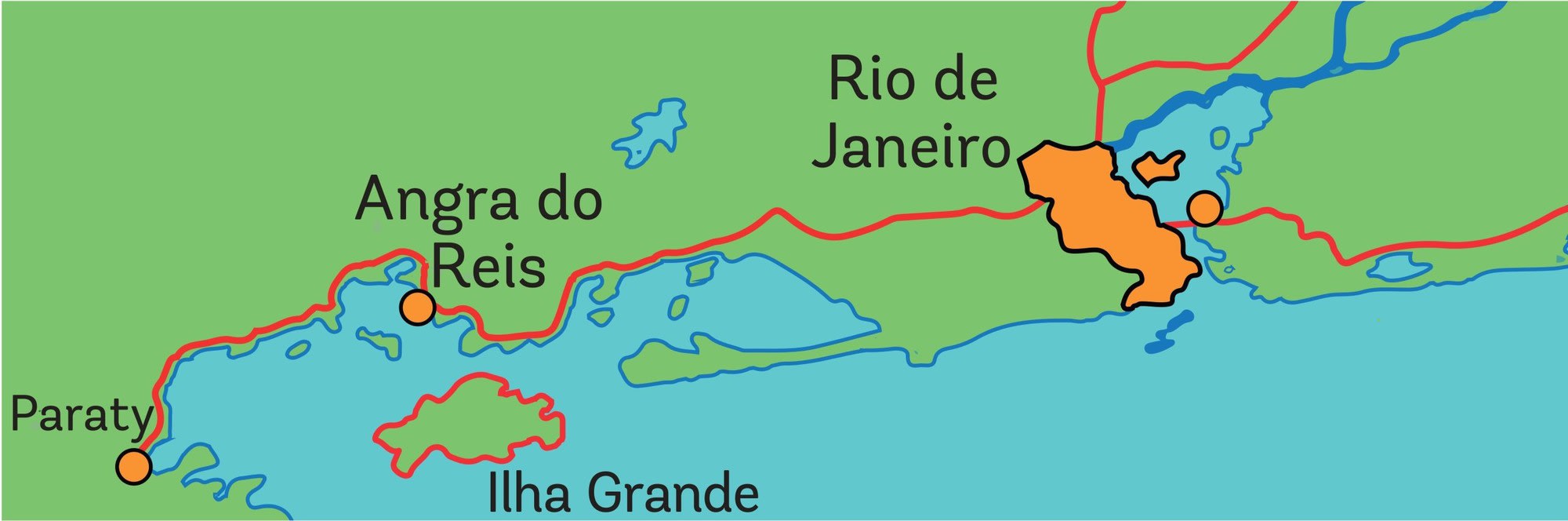 The Costa Verde region at the South of Brazil
- Day 0: Early flight Buenos Aires to Rio de Janeiro. Copacabana, Ipanema.
- Day 1: Early bus to Angra dos Reis, check-in at Nacional Inn Hotel.
- Day 2: Day tour to Ilhas Paradisiacas
- Day 3: Scuba Diving day at Ilha Grande, Christmas Dinner.
- Day 4: Day tour to Ilha Grande beaches
- Day 5: Relaxing day at the hotel.
- Day 6: Early bus to Rio de Janeiro, spend the day at Barra de Tijuca.
- Day 7: Early flight back to Buenos Aires.
Rio de Janeiro
We landed in Rio at noon, and since Uber pickups were remarkably well-organized and cheap at the airport, we were soon on our way to Copacabana (~1 hour away from the airport). We stayed at Astoria Palace Hotel, which was a little dated (like most hotels in this area), but perfectly located right on Av. Atlantica, the main street along the Copacabana beachfront.
[carousel]
 View of Copacabana from the hotel rooftop
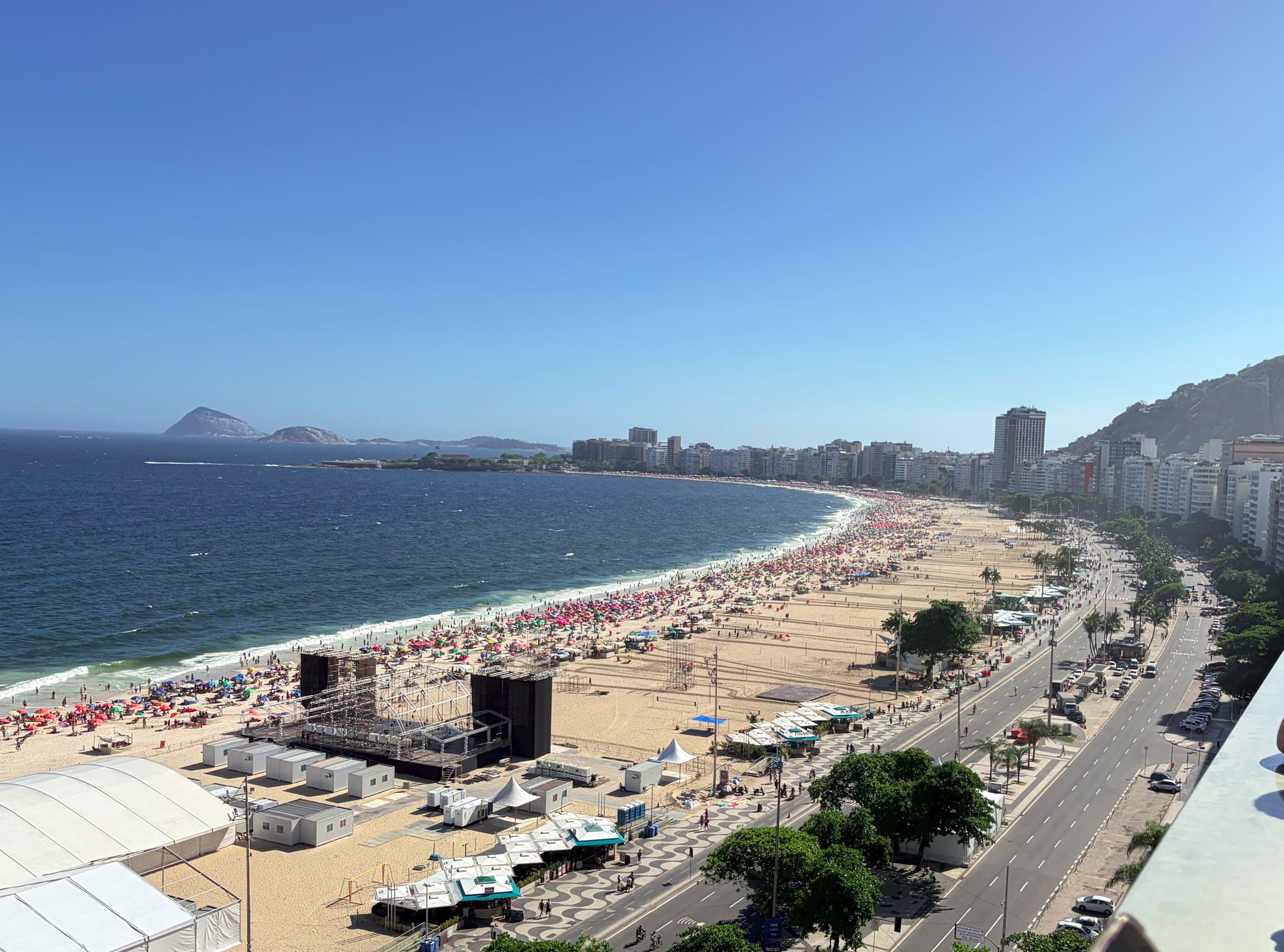 View of Copacabana from the hotel rooftop
[/carousel]
The first thing we did was go up to the hotel rooftop and take in the views. Copacabana and Ipanema are impressive when seen from above: extremely long coastline, scenic green mountains in the background, and crowds of people sunbathing and playing in the sea. We had lunch next to the hotel; most restaurants offer executive lunch menus that are very inexpensive, healthy, and delicious.
In the early afternoon, we walked down to the beach. I particularly enjoyed playing in the Copacabana sea because it has quite strong waves—it’s not the quiet, calm water pool that you’ll find elsewhere. However, I soon grew tired because the sun was blazing hot. This was common throughout the vacation: sunset is before 7 PM, but up to 5 PM the sun literally scorches you. I’m not fond of burning under the sun, but my travel companions actually enjoy it, so I had to struggle to find shady spots.
After a few hours, with the energy burst that only first-day excitement usually entails, we rode scooters up to Ipanema with my partner’s nieces. Walking, biking, or riding a scooter along Copacabana up to Copacabana Fort, and then through Ipanema, is a must on any trip to Rio, and we enjoyed ourselves taking in the views.
I was stunned to see so many fit people. Rio de Janeiro attracts quite the crowd of bodybuilders and gym goers. We finally sat down at a beachfront stand in Ipanema, and drank smoothies while watching the sunset. Beautiful first day!
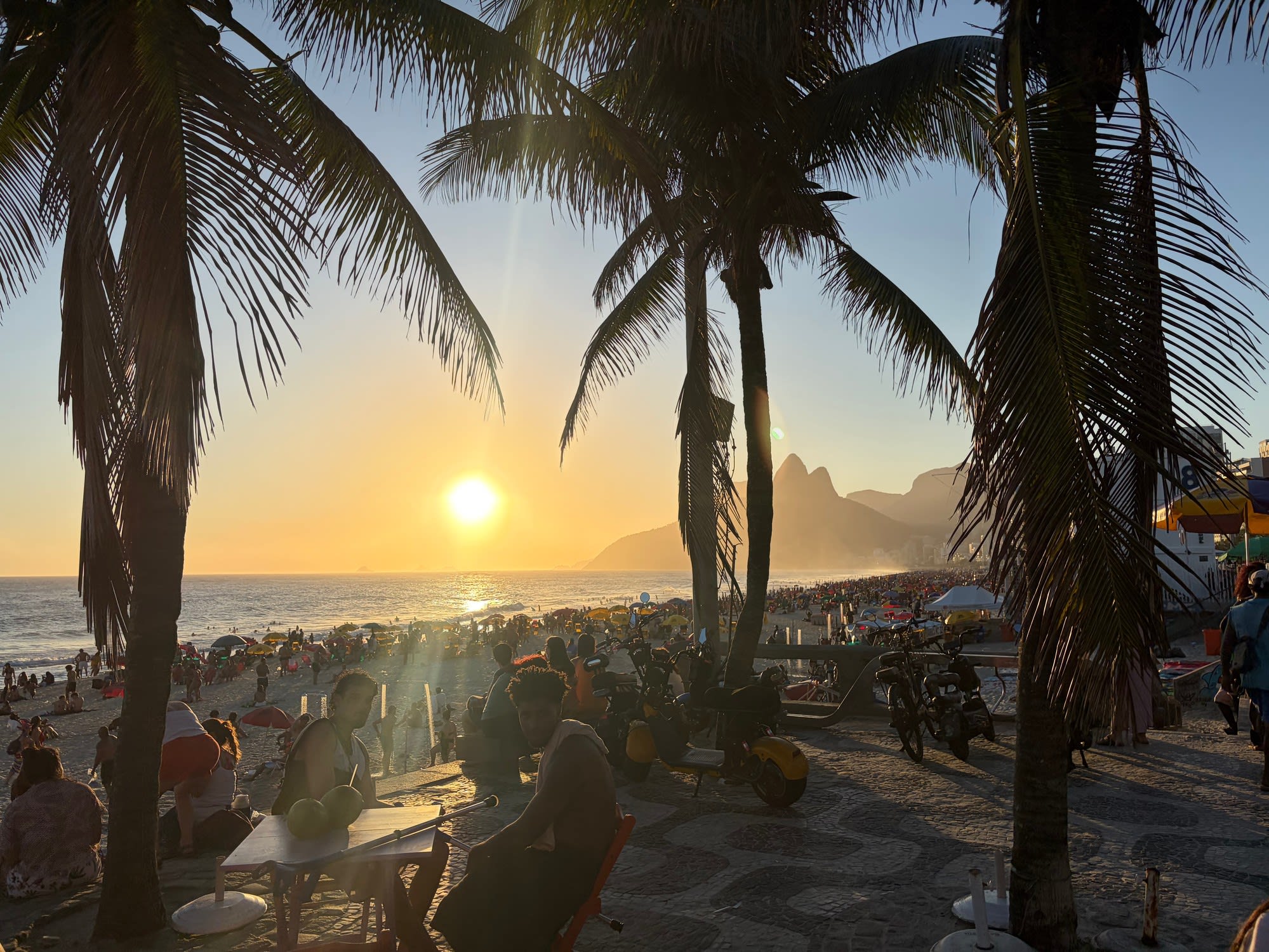 Sunset at Ipanema
Day 1: Rio de Janeiro to Angra Dos Reis
Reaching Angra from Rio is actually quite simple and inexpensive. A 3-hour bus operated by Costa Verde departs every hour from the main bus station (Rodoviaria Rio), at a cost of about 15 USD each way.
 Lush landscape views from the bus window seat
The hotel (Nacional Inn) was nice enough, especially the pool which visually looked as if ending in the sea. The hotel looked a bit dated, as though it had seen its splendour one or two decades ago, but it’s still very well maintained, and the staff is very friendly.
 Me sunbathing at the hotel swimming pool, overlooking the sea
[carousel]
 Beautiful sunsets guaranteed every day
 The hotel swimming pool and the sea beyond
[/carousel]
After seeing the basic infrastructure of the town, I am quite confident that we stayed at the best hotel available. However, I would advise people to try and book accommodation in the neighboring Ilha Grande. Angra dos Reis proved to be a relatively boring town, not particularly interesting to sightsee, and you’ll need to hire day tours by boat every day to go out and visit the actual beautiful spots in the area.
Day 2: Ilhas Paradisiacas tour from Angra
We did a 6-hour group tour (33 USD/person) that departed from the hotel: a boat picked us up and stopped in a number of islands and beaches; about 1 hour stops at each place.
- Ilhas Botinas: snorkeling spot
- Praia do Dentista
- Lunch stop at Praia das Flechas (Isla Gipoia) → caipirinhas and fried chicken for lunch
- Ponta da Piedade → decent snorkeling, a cute church.
This is the template for all the tours offered in the area: hop on and off interesting stops by boat.
[carousel]
 Ilhas Botinas: people would jump either with snorkel gear or just with their swimsuits and swim/snorkel. This was the best snorkeling spot; we saw a squid, first time for me.
 Praia do Dentista
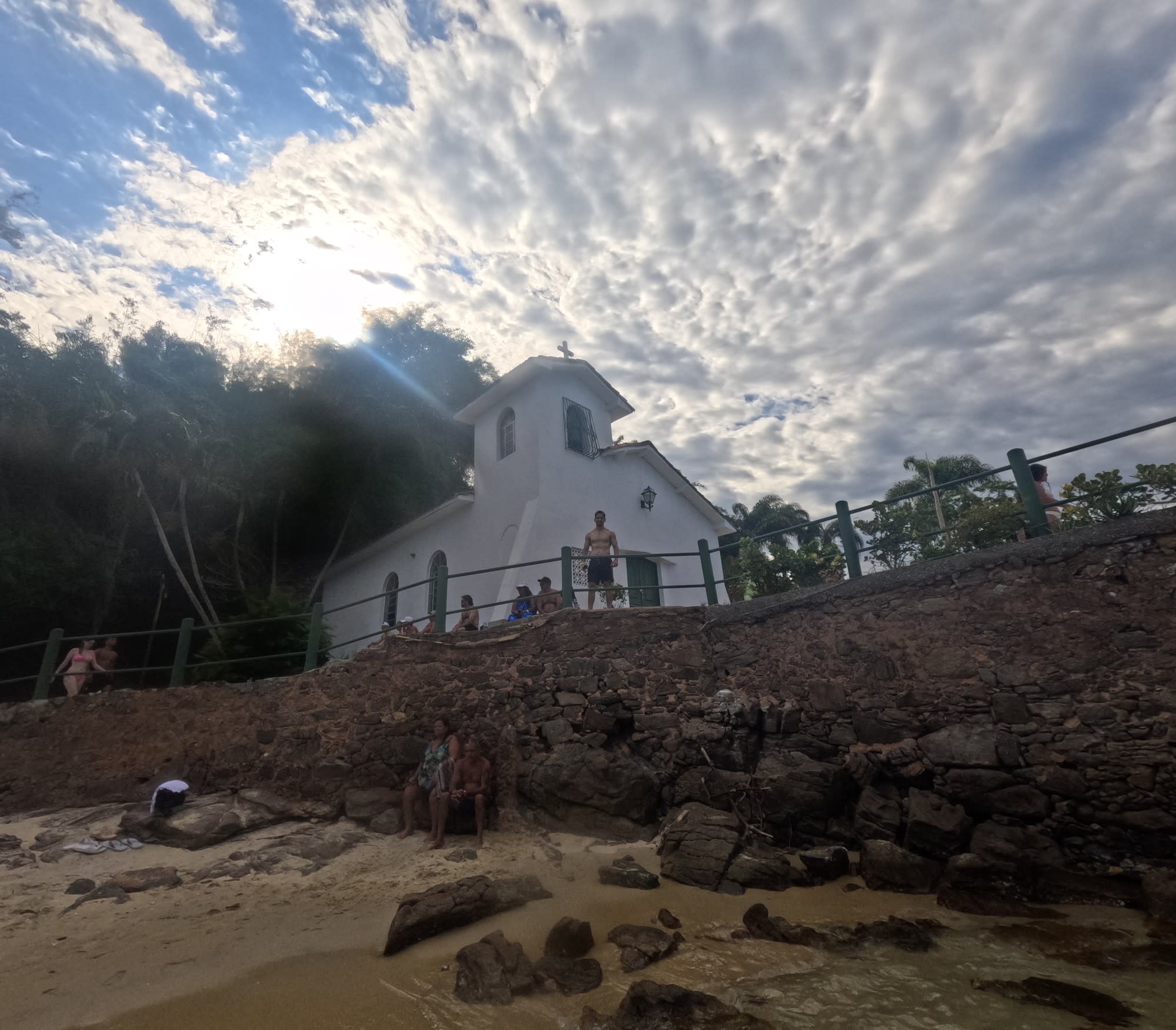 Praia da Piedade: Church as seen from the sea
 Angra Dos Reis, as seen from the sea
 Praia da Piedade
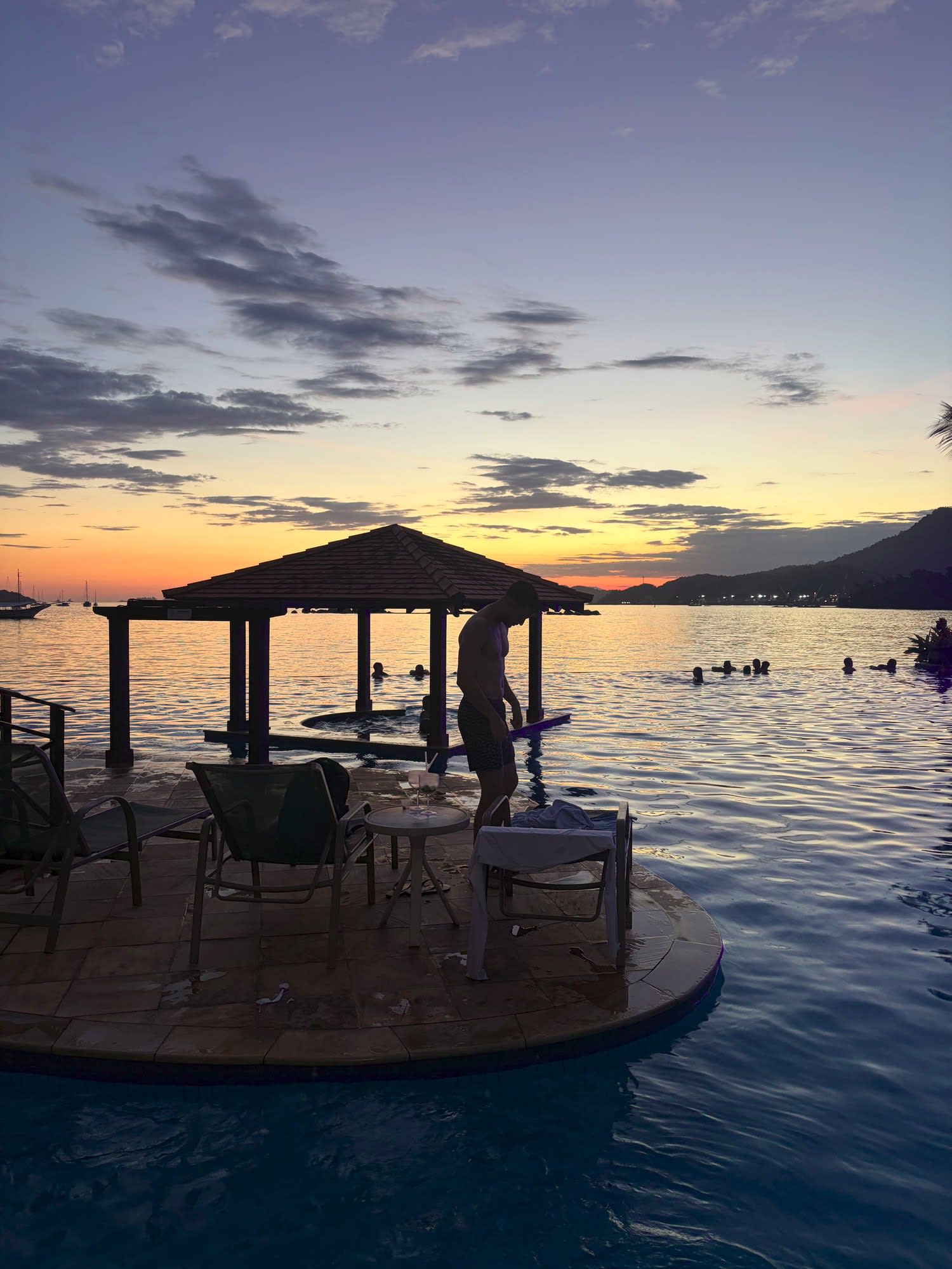 Sunset back at the hotel
[/carousel]
Day 3: Diving in Ilha Grande & Christmas Evening
This was a solo day, since no one else in the travel party was certified to dive—both exhausting and rewarding. The logistics were a nightmare, and it illustrates why staying at Ilha Grande would be much more convenient than staying at Angra:
- Wake up at 6 AM, grab breakfast
- Uber to Santa Luzia, the ferry terminal at Angra Dos Reis
- Queue for the 7:30 AM transfer; it is not possible to book online, first come first served.
- 1h+ boat transfer to Abraao, the main town at Ilha Grande
- Show up at the dive shop Dive & Cia
- 1h+ sail towards the first diving spot
- 50’: First Dive!
- 1h+ sail to the second diving spot
- 50’: Second Dive!
- 1h+ sail back to Abraao
- 1h+ sail Abraao -> Santa Luzia
- Uber to the hotel
Abraao is charming, a bit chaotic, very lively. I was only free to stroll the waterfront for about 30 minutes, and I noticed very basic infrastructure (a small supermarket, a few restaurants and coffee shops, and travel agencies selling day tours) with a charming island atmosphere.
[carousel]
 Waterfront of Abraao
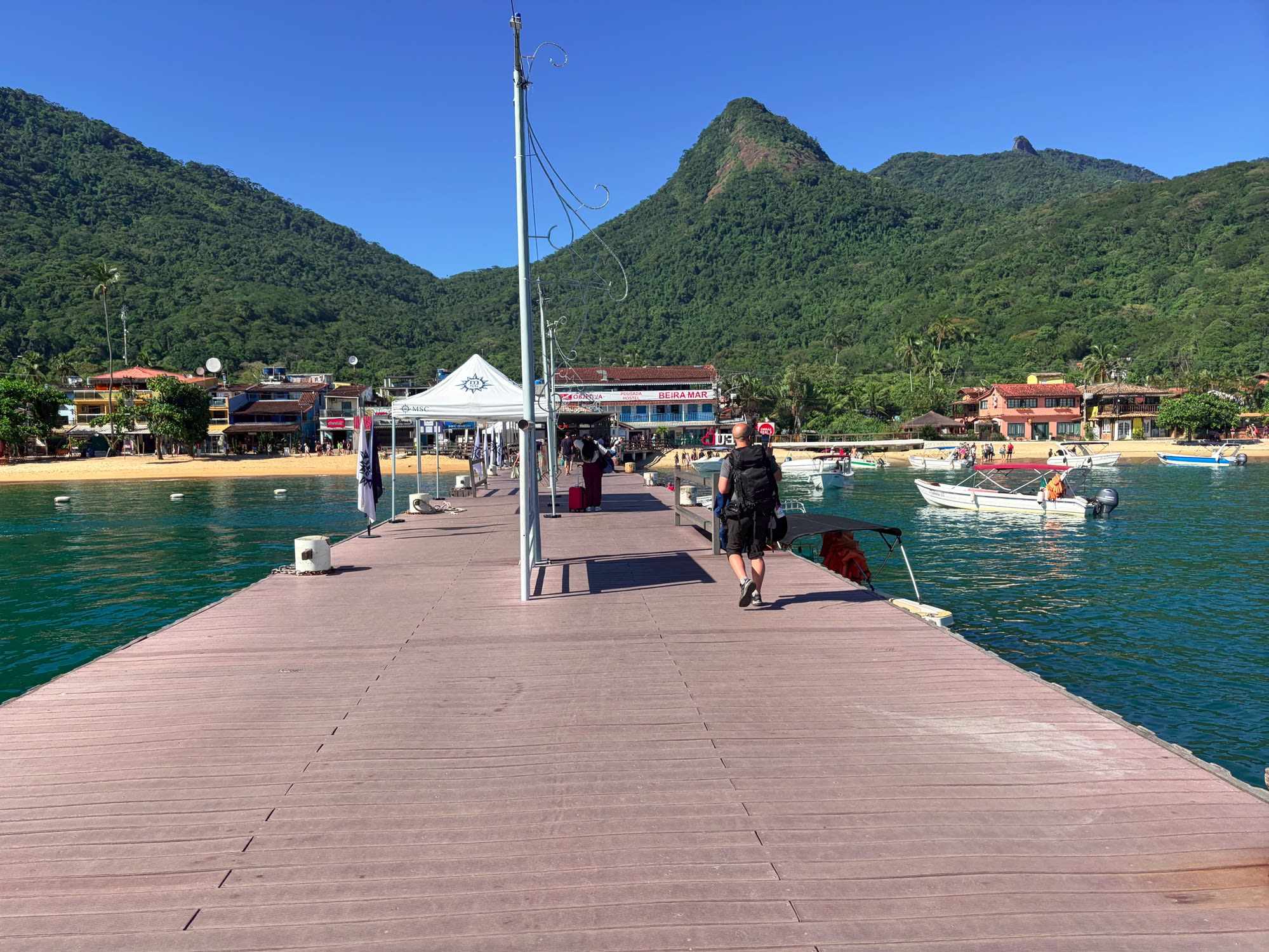 First view of Abraao
 Streets of Abraao
[/carousel]
The dives were worth the long day. I saw quite a lot of marine life: large starfish, a seahorse, schools of sergeant major, super colorful corals (different textures and colors: yellow, green, red, blue), honeycomb cowfish, angelfish, porkfish, a bunch of unique flying gurnard (I’d never seen those!), and more.
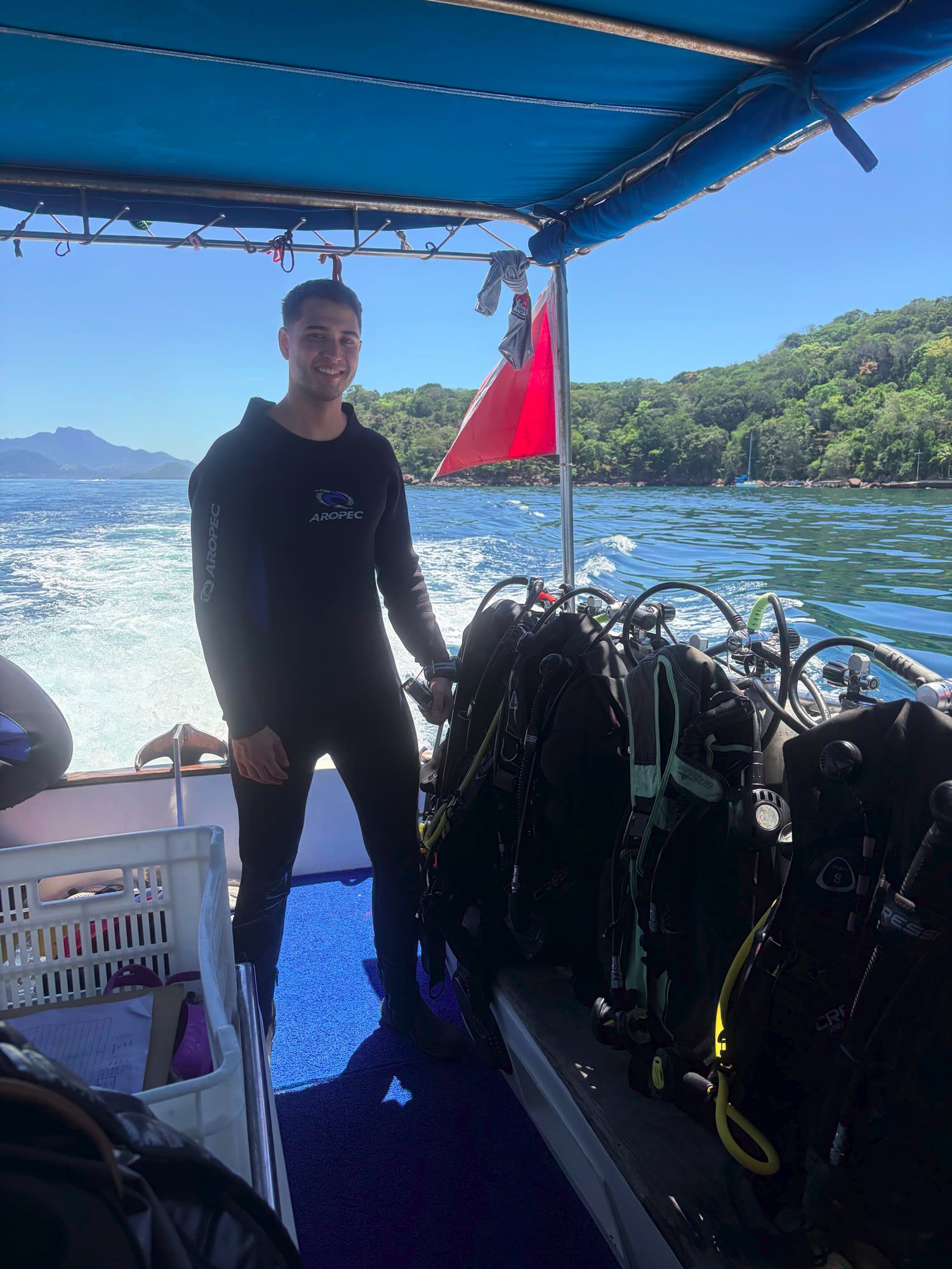 Before the first dive
 We dived near the north side of the island
Visibility underwater is really poor though—under 7 meters. At times I feared I’d miss the dive guide. For comparison, in my last dives at Easter Island, visibility was 30 to 60 meters. The boat was also really slow; I would not really recommend this diving agency to others.
Marine Life
As an avid diver, I spent quite a lot of time getting to know the marine biodiversity that the island has to offer and trying to capture them with my GoPro. Here is a selection of my favorite sightings!
Fish & Mollusks
[carousel]
 A Caribbean Reef Squid! Masters of color change, they flash vivid patterns to communicate, camouflage, and confuse predators.
 Sergeant Major, the most common fish throughout the dives and snorkeling experiences.
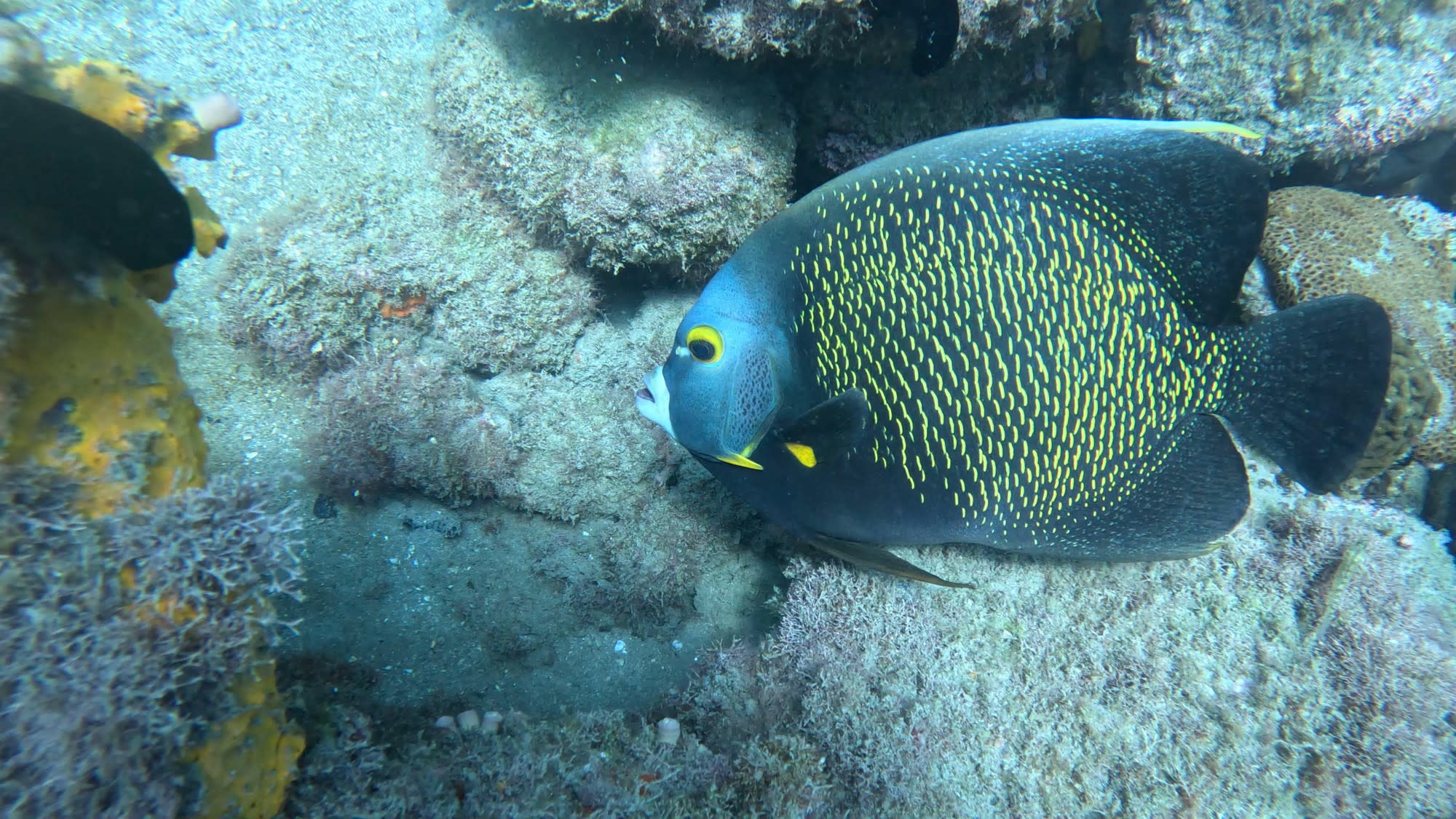 French Angelfish
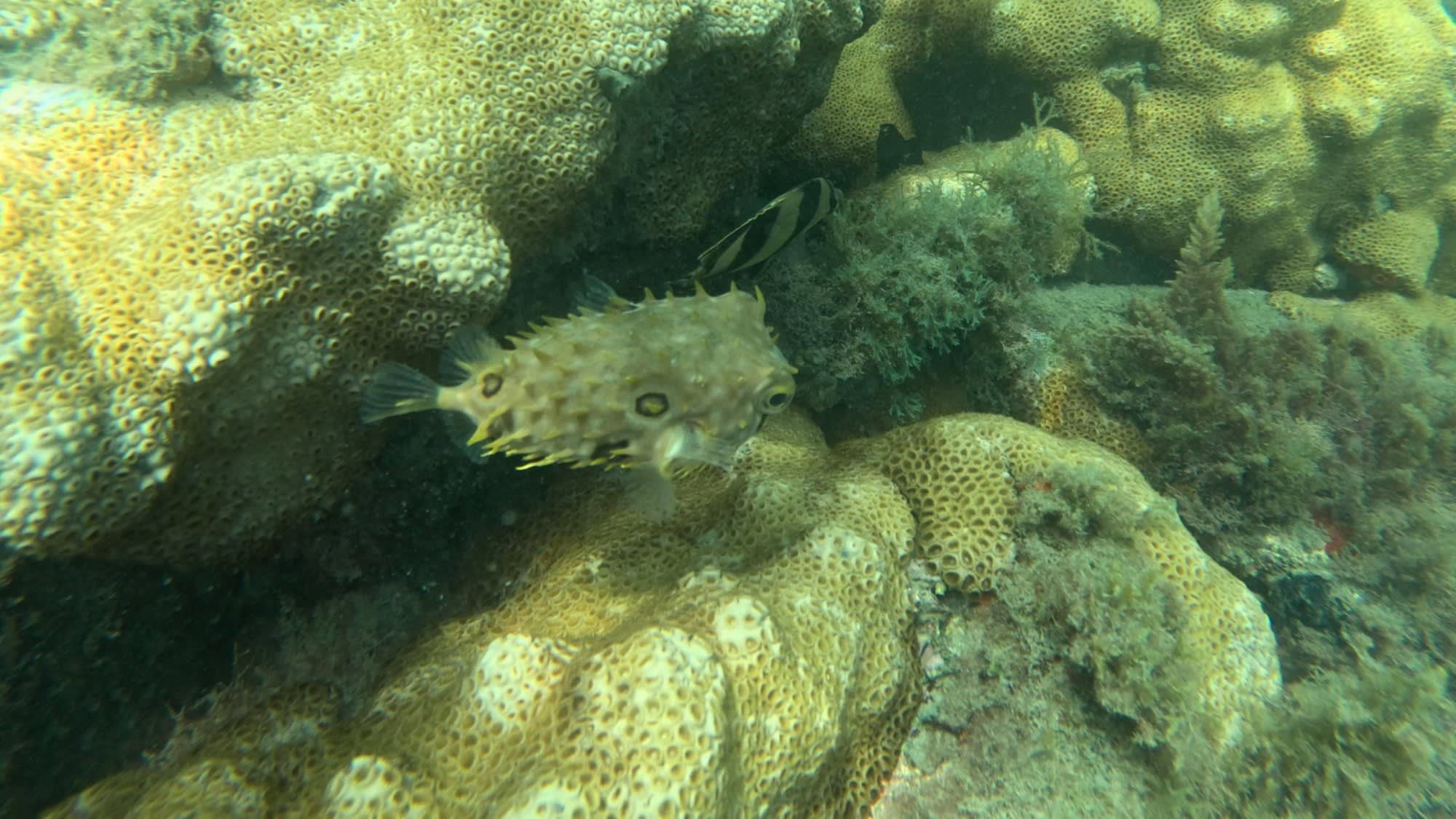 Porcupinefish (Chilomycterus spinosus): Inflates its spiky body to scare predators and can release toxins, making it one of the ocean’s “puffiest” defenses.
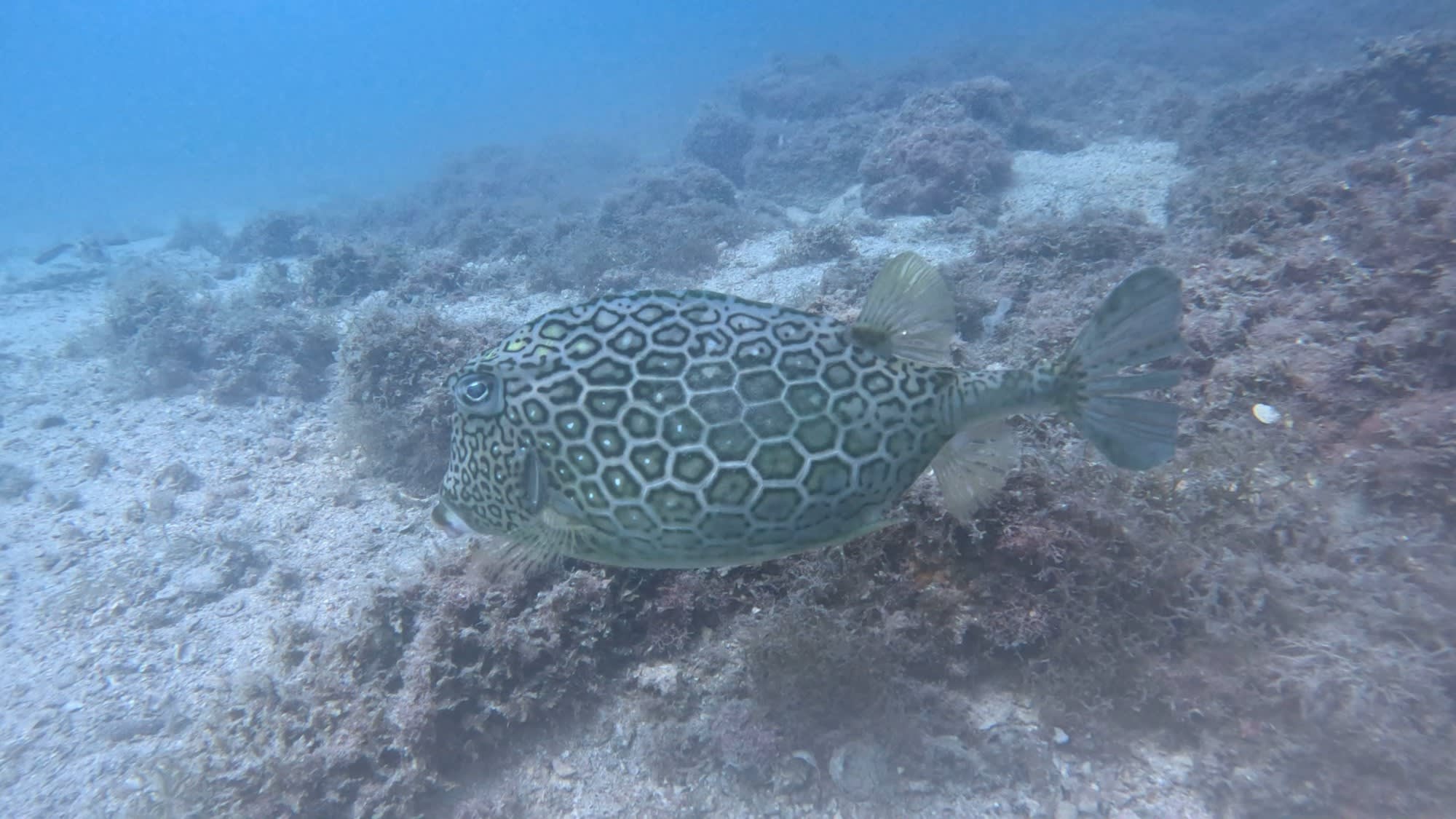 Honeycomb Cowfish (Acanthostracion polygonius): Named for its hexagonal patterned armor, it swims awkwardly but looks like a living geometric sculpture.
 Flying Gurnard (Dactylopterus volitans): Opens its enormous pectoral fins like wings to startle predators and glide short distances along the sea floor.
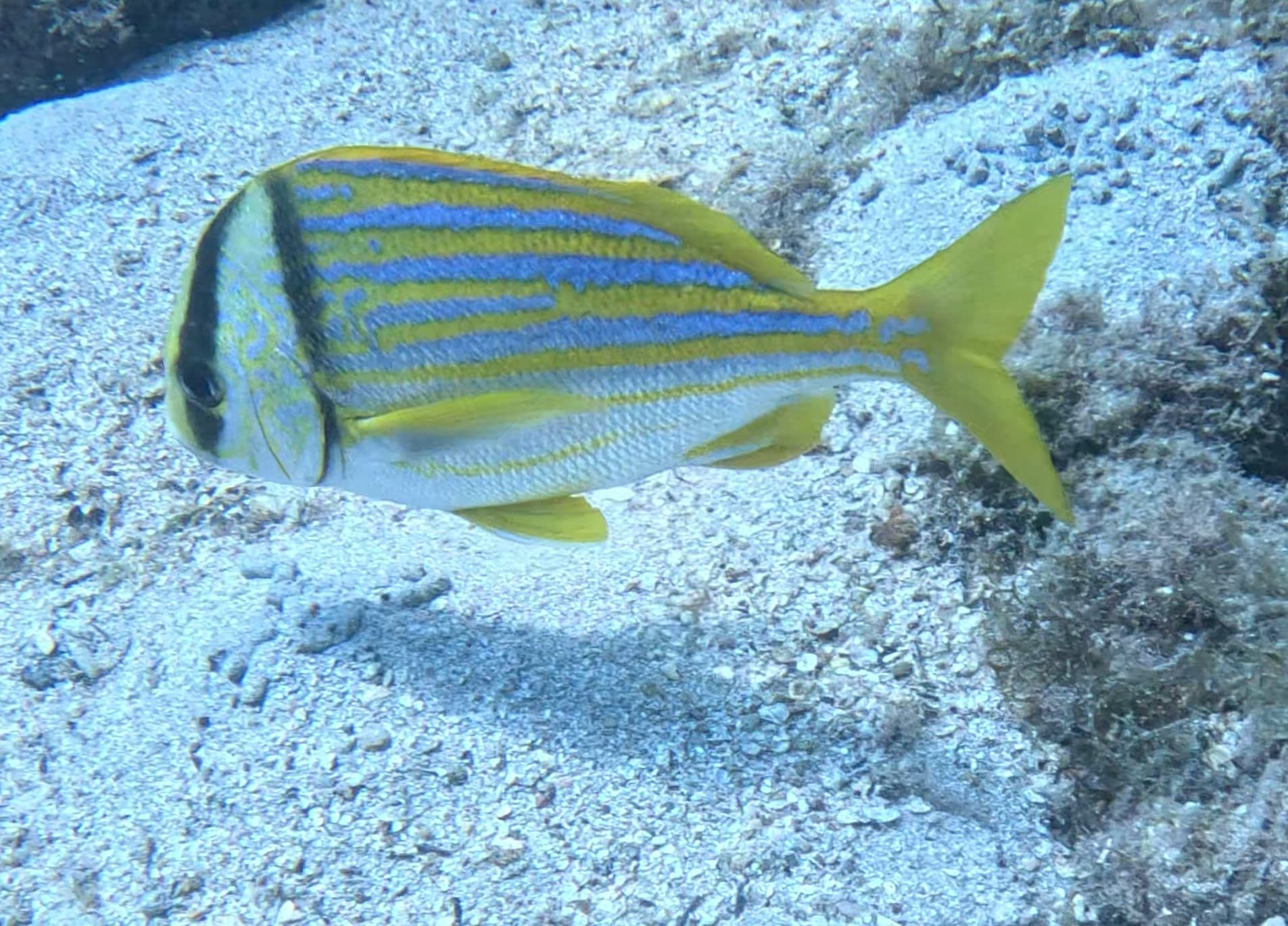 Porkfish (Anisotremus virginicus)
 Squid! I had never seen one. Apparently a Caribbean Reef Squid.
[/carousel]
Sea Horse
I was lucky enough to see two seahorses, the one I managed to get good pics of was a Hippocampus reidi (Longsnout Seahorse) that I found while snorkelling!
[carousel]
 Longsnout Seahorse
 Longsnout Seahorse
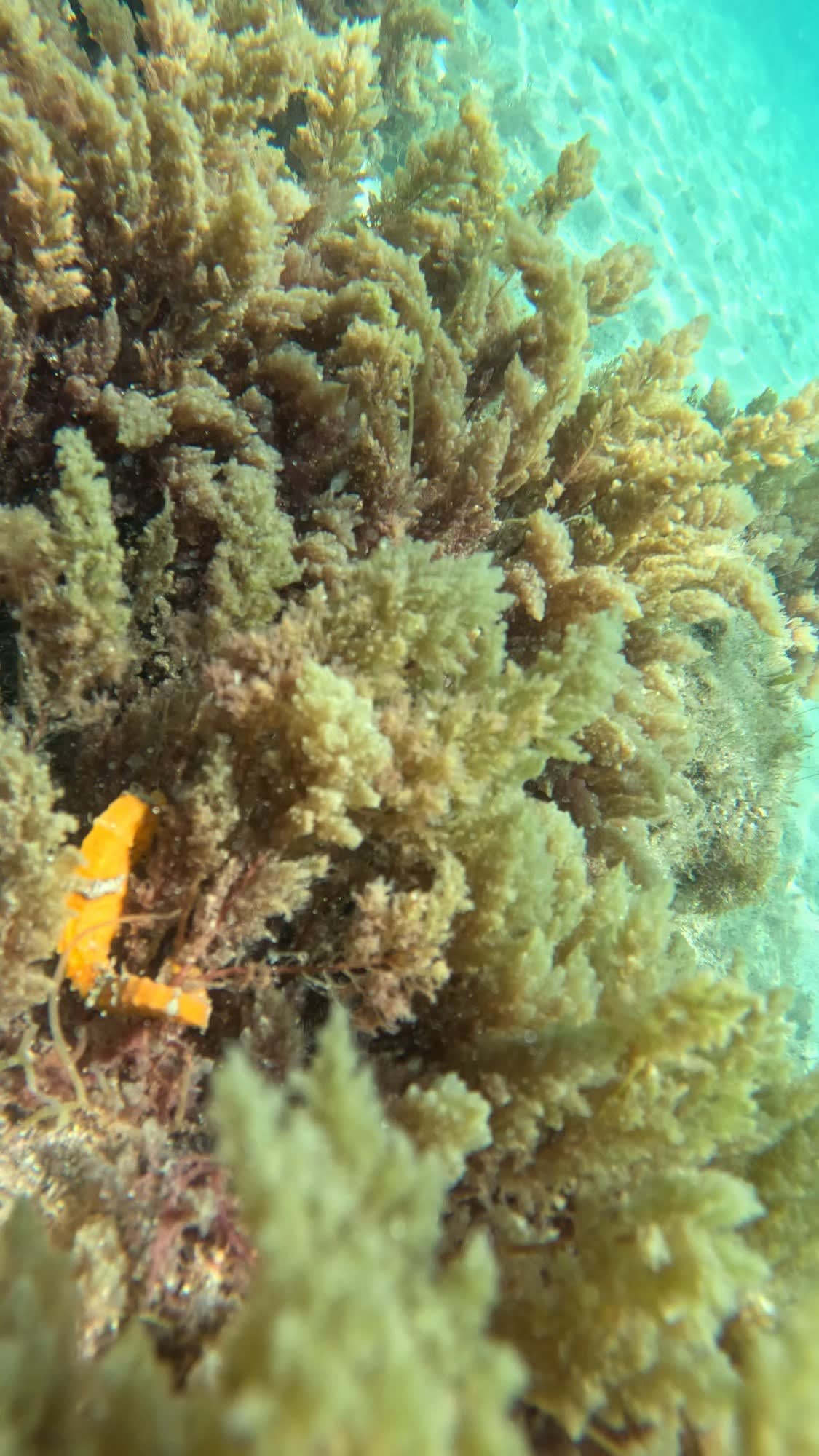 Longsnout Seahorse
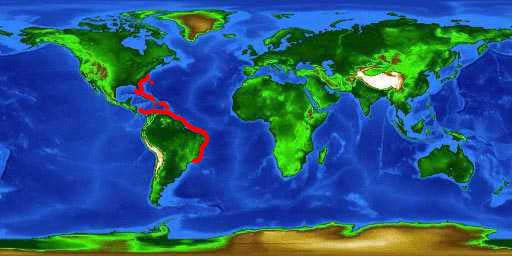 Area where the Longsnout Seahorse can be found
[/carousel]
101 seahorses! Seahorses are tiny marine fish with horse-shaped heads and upright swimming posture.
- Bodies are covered in bony rings instead of scales.
- Tail is prehensile, used for grasping seagrass or coral branches.
- Size varies: 10–20 cm for longsnout species.
- Swim very slowly using tiny dorsal fins for propulsion.
- Males carry eggs in a brood pouch, where embryos develop safely. After gestation, males “give birth” to fully formed miniature seahorses.
- Can change color to blend with surroundings: coral, seagrass, or sponges.
Sea Stars
[carousel]
 Cushioned sea star - only seen while diving
 Cushioned sea star, closeup. Check out the spines! Cushion stars can reach up to 40 cm and move very slowly using hundreds of tiny tube feet on its underside.
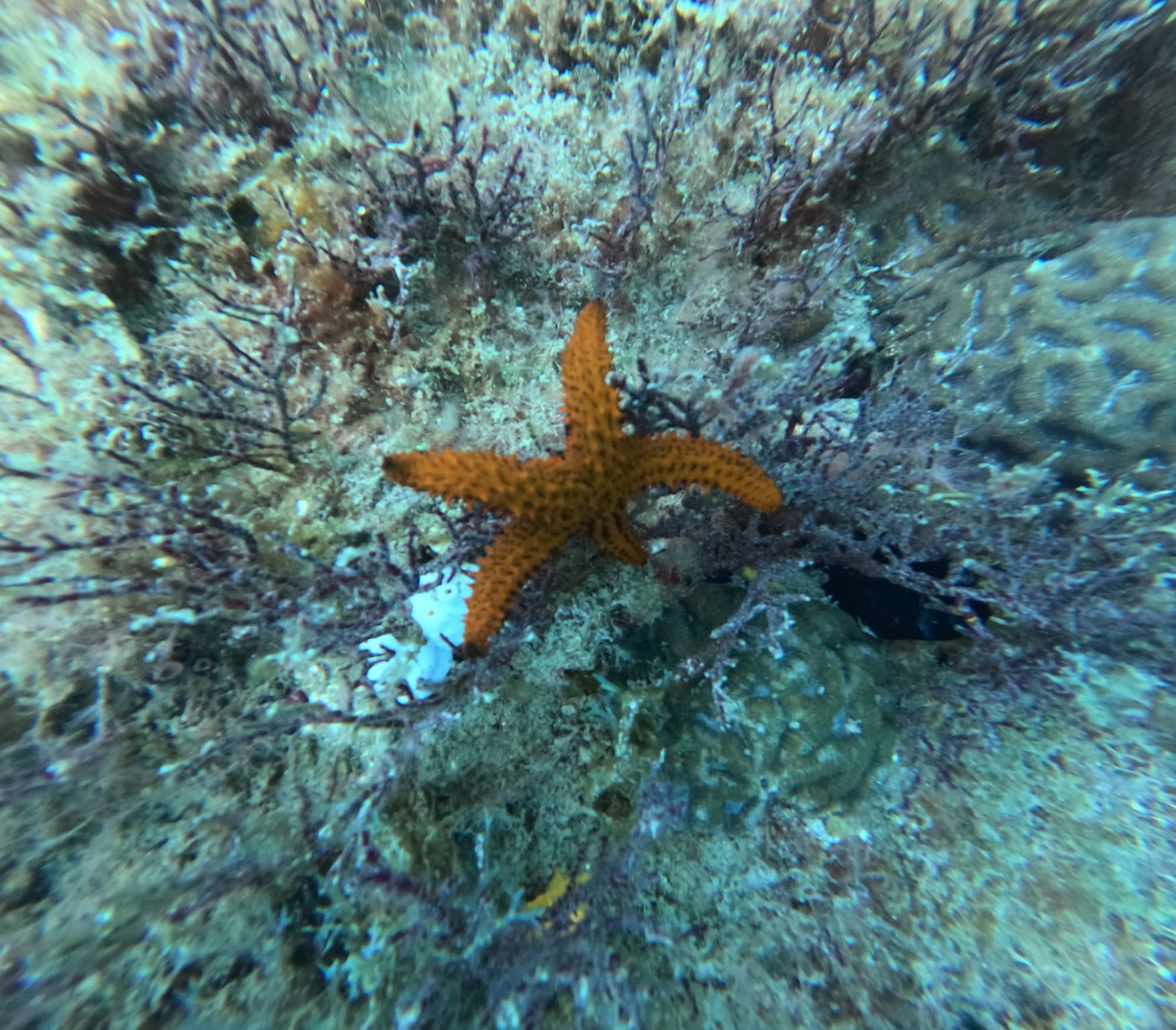 Brazilian red sea star (Echinaster brasiliensis)
 Possibly a Common Comet Star
[/carousel]
101 stars! Sea stars (often called starfish, though they aren’t fish) are marine invertebrates belonging to the group of echinoderms.
- They have a mouth and can push their stomach out through the mouth to digest food outside their body!
- Most have five arms, but some species have more.
- They move slowly using tiny tube feet, about 2 to 15 cm per minute.
- They have no brain, but a nerve ring and radial nerves on each arm.
- Some species have simple eyes at the tip of each arm, able to detect light and dark (not detailed images)
- They can regenerate! Many sea stars can regrow arms, and some can regrow an entire body from a single arm
- Most stars have separate sexes and reproduction happens by broadcast spawning. Some species can reproduce asexually by splitting.
Corals & Landscapes
The density and color of corals was impressive, particularly bright shades of yellow, red, blue, pink, and green. I was a little sad to learn that most of these are invasive species, though.
[carousel]
 A wall of multicolor corals
 Sun Coral (Tubastraea), a beautiful yet major invasive species. It comes in beautiful green, orange, and yellow versions
 More sun coral
 A Sea Urchin next to colourful coral
[/carousel]
Spending Christmas night at Angra was not a good idea. Everything was closed, including all restaurants. After a thorough and stressful search we found only 2 options for dinner: hotel restaurants that offered highly overpriced buffet dinners specially for Christmas. The food was not good, the staff (understandably) was not very happy to be working on a holiday, and I was left wishing we had had an apartment with a kitchen where we could’ve celebrated in our own way.
Day 4: Tour to Ilha Grande
Yet again, the whole family joined a group boat tour to visit several spots around Ilha Grande. The first stop was undoubtedly the best one because I found the beautiful orange seahorse I showed before!
- Lagoa Azul
- Praia de Grumixama
- Praia de Araca
- Praia das Flechas (lunch stop)
- Ilha de Categuas
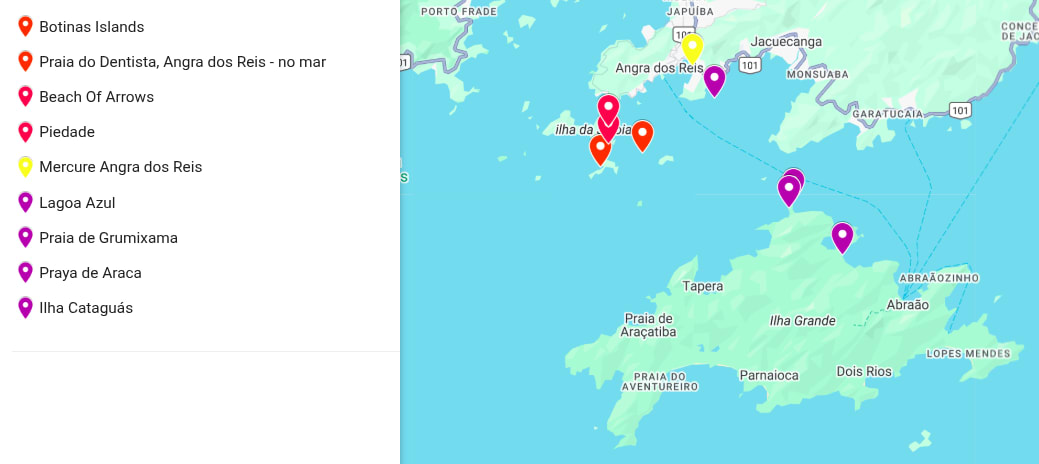 Map with the spots we visited on the Ilhas Paradisiacas (red) and Lagoa Azul (pink) tours.
This proved to be the best tour, excluding the dives. Had I only had time for a single-day tour, I would’ve done this one. Lagoa Azul was beautiful; we plunged into calm sea, about 3+ meters depth, snorkeling or just floating around. I loved it.
[carousel]
 Lagoa Azul
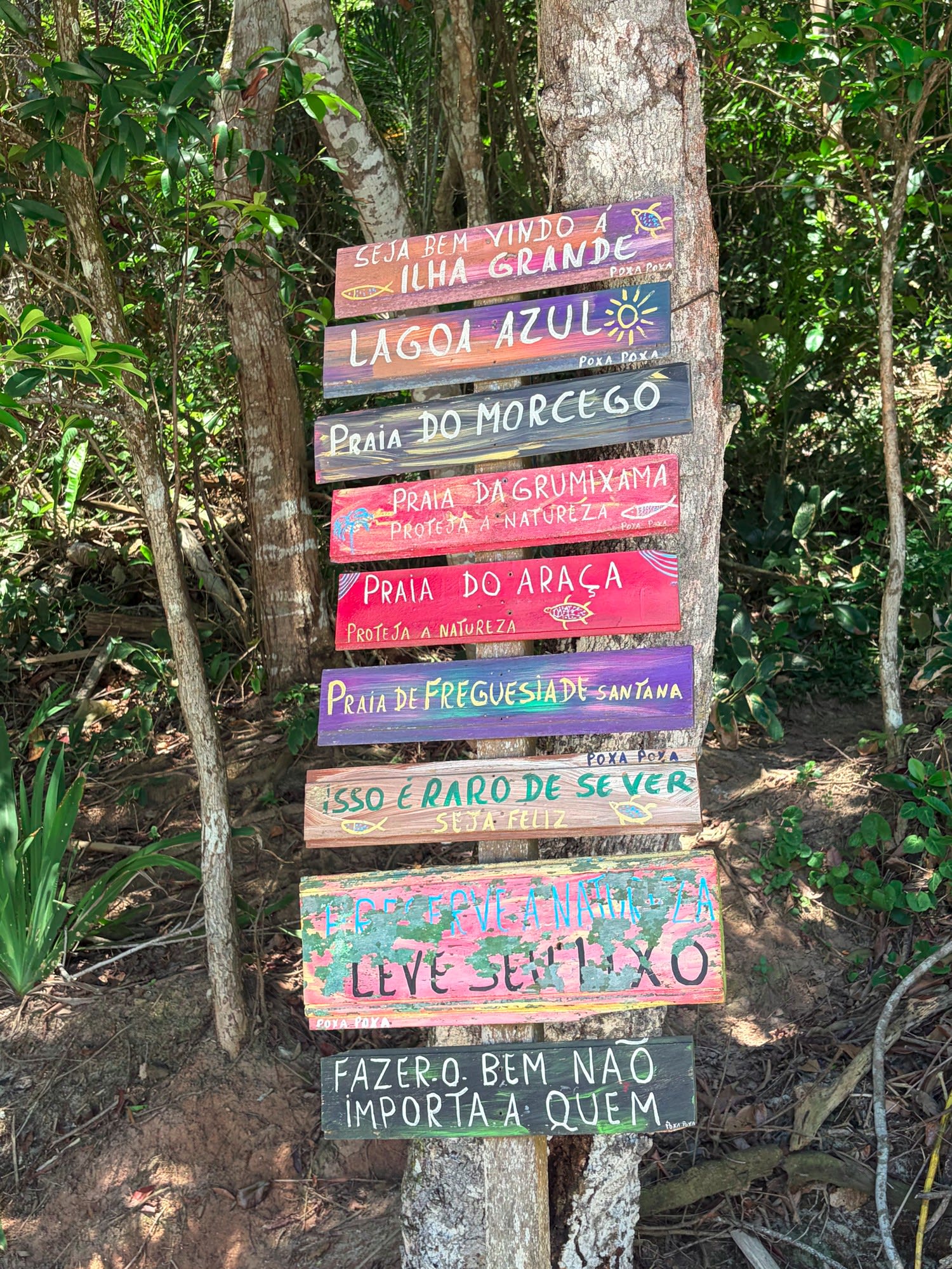 Here I walked a little bit in the jungle!
 Last sunset in Angra
[/carousel]
Last sunset in Angra
[/carousel]
Grumixama Beach was even better—you could swim to a nearby beach as well, and if you ventured a little further into the sea, there was the best snorkeling spot on the island. Here we found both the seahorse and two turtles.
Barra de Tijuca
December in Brazil can be unbearably hot, and the last days were terrible: over 40 degrees. We rode the Costa Verde bus back to Rio de Janeiro, then took an Uber to our hotel Windsor Oceanica in Barra de Tijuca, another 1-hour drive.
Here is a great piece of advice: modern, fancy hotels are extremely cheap in Barra de Tijuca (half the price of Ipanema and Copacabana). The beach is beautiful, with clearer waters than anywhere else in Rio, and lively nightlife. If I ever come back to Rio, I will make sure to stay at Barra.
I discovered açaí on the last day and quickly became a fan: healthy, refreshing, and delicious. There are many shops specialized in it around Barra.
Barra de Tijuca had many highlights. Firstly, the sunset from the Windsor rooftop swimming pool. Secondly, the massive BarraShopping mall, where I found a huge bookshop where I’d have spent hours had I had more time. Lastly, the lively restaurant street where we had dinner and several caipirinhas. [carousel]
 Rooftop view of Barra de Tijuca, right after sunset
 Livraria da Travessa at BarraShopping
 People bathing at night in the sea. The beach was crowded for miles, as if it was mid afternoon.
[/carousel]
I had a delicious dish of tuna with boniato at a restaurant called BROU, located on the waterfront avenue Lucio Costa. There were many restaurants, one next to the other, offering all types of cuisine ranging from Asian to Brazilian Grill. Highly recommended!
Practical Tips
- Currency: All transactions are conducted in the local currency, the Brazilian Real (BRL). We didn’t need to use any cash at all, electronic payments are accepted everywhere and tips are included in the checks.
- Transport: Uber is extremely cheap and was available everywhere. We would often take 1h Uber journeys for as little as 60 BRL (~10 usd).
- Safety: There are many sketchy areas around Angra Dos Reis, and Rio is famous for its dangerous Favelas. Make sure you stay in touristy areas, which felt very safe to us. We were very careful not to leave unattended objects in the beach, and to not flash our smartphones in the streets.
- Accommodation: We booked everything via Booking.com. Accommodation in Barra de Tijuca was particularly affordable.
- Flights: We flew Gol from Buenos Aires to Rio; and Flybondi from Rio to Buenos Aires. Flybondi is infamous for its delays, scrubby airplanes and terrible service. We booked too close to the date and we had no other reasonable choice, but I’d seriously try to avoid it if possible.
- Caipirinha: Be prepared to drink a lot of caipirinhas! They are sold everywhere, delicious and generally cheap (20 to 40 BRL).
Final Thoughts
Brazil’s Costa Verde left me with mixed but memorable impressions. At its best, the region offers stunning island landscapes, clear waters, and a rich marine ecosystem—particularly around Ilha Grande, where snorkeling and diving were consistently rewarding. Exploring this underwater world was the true highlight of the trip and the main reason I would happily return.
December, however, is not an easy time to travel here. The intense heat and heatwave conditions made long days outdoors challenging. Logistically, Angra dos Reis works well as a base, but it lacks character and requires daily boat tours to reach the area’s real gems. If I am ever back, I’d base myself in Ilha Grande.
Rio de Janeiro and Barra de Tijuca provided a welcome contrast at both ends of the journey—from iconic beaches to modern, comfortable hotels and excellent food. Ending the trip in Barra, in particular, was a great decision!