Easter Island: Standing with Giants at the Edge of the World
Hanga Roa → Rapa Nui National Park
Easter Island, the Land of the Moai
Set adrift in the immensity of the Pacific, over 3000 km from the nearest continent, stands Easter Island, or Rapa Nui, a remote volcanic speck known for its enigmatic moai. Not only did the Polynesians managed to reach this remote place, but they flourished here, carving and transporting hundreds of these monumental stone figures.
 Partially buried moai at Rano Raraku quarry
Visiting Easter Island had been on my bucket list since my teenage years, a fascination strengthened even more after travelling through Hawaiʻi and French Polynesia, two distant corners of the same Polynesian world. So when the opportunity finally came, I didn’t hesitate.
Together with my friend Nadia, I spent four unforgettable days on Rapa Nui: mornings scuba-diving, afternoons among ancient archaeological sites, evenings watching the sun fade behind the waves, and nights filled with fresh tuna and cocktails. In this post I’ll share everything we saw, did, and learned!
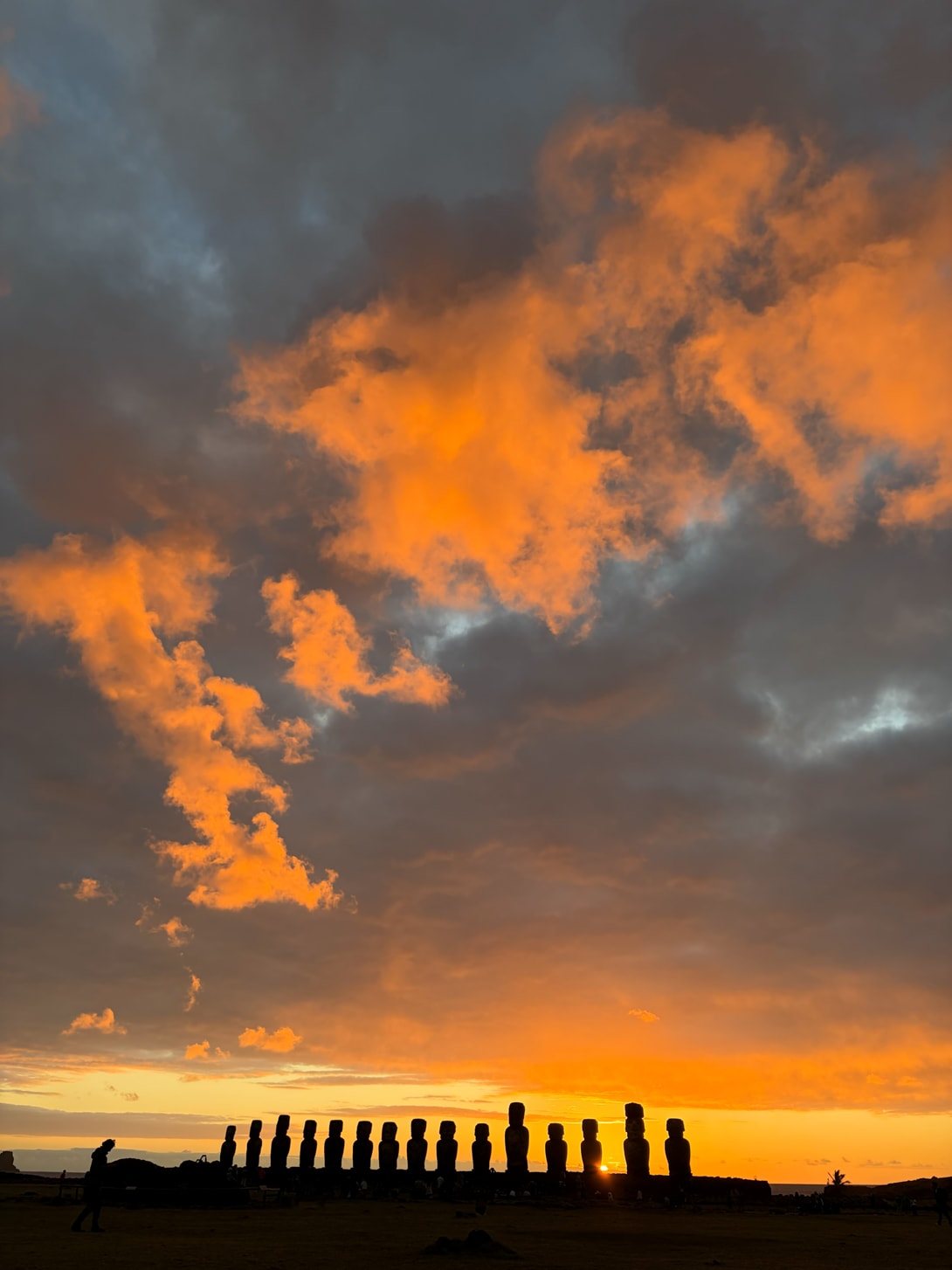 Sunset in Ahu Tongariki
[content_table]
A dot in the immensity of the Pacific Ocean
It’s easy to underestimate the remoteness of Easter Island, but don’t be deceived: there’s no human settlement around for thousands of kilometres, the closest being Pitcairn Islands at 2000 km with just about 40 permanent residents. That’s part of the draw of visiting, to literally get away from everything.
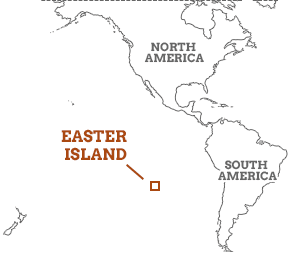
As of 2025, you don’t really have any options to reach Easter Island. The only commercial flight is operated by Latam Airlines from Santiago de Chile. There used to be a connection from Tahiti, but it is very unlikely it will be resumed, as it was not very profitable.
Depending on the season, there are either one or two daily flights, and with a flight time of 5 hours, the island being a staggering 3759 kilometres away from Santiago.
 Easter Island is one of the three edges that geographically define Polynesia
Itinerary
We spent about 4 full days in the island, and since we visited in late November, we had over 14 hours of daylight to explore ever day. Easter Island is relatively small, and you can drive around it in less than two hours, so we had plenty of time to visit all the interesting sites.
 A map of Easter Island, a blue dot for each picture I took during my visit.
Day 1, Nov 27
- Flew SCL -> IPC, arriving at 3 PM
- Strolled around Ahu Tahai & Hanga Roa Town
Day 2, Nov 28
- Morning: Two-tank Dive at Hanga Roa Bay
- SW sites: Orongo Village, Rano Kau volcano, Vinapu
- Anakena Beach ; Ahu Huri a Urenga
- Dinner and live music at Ohi Sushi
Day 3, Nov 29
- Morning: Two-tank Dive at Hanga Roa bay
- NE sites: Rano Raraku ; Ahu Tongariki ;Vaihu
- Island round trip by car, Anakena
Day 4, Nov 30
- Interior sites: Ana Te Pahu (Caves) ; Ahu a Kivi - Ahu a Tiu ; Puna Pau
- NW Sites: Papa Vaka petroglyphs; Te Pito Kura ; Ovahe Beach
- Anakena, Ahu Ature Hora / Ahu Nau Nau / Ahu Ature Huki
Day 5, Dec 1
- Sunset tour to Tongariki
- Fly back to Santiago
Sightseeing Easter Island
Arriving at Easter Island
There is a single town in Easter Island, called Hanga Roa. The airport is located at the southern edge of the town, and the host of the Cottage we booked was waiting for us when we arrived. He drove us through town, and stopped by the visitor centre so that we could purchase our National Park tickets (USD 100 each) before dropping us at the cottage.
 Easter Island greeted us with blue skies and a tiny wooden airport, very reminiscing to the airports in French Polynesia
We stayed really close to Ahu Tahai, and had direct view of the sea and sunset. I’d say anywhere near Hanga Roa bay is a good place to stay, since most restaurants and touristic services are there.
Tahai Ceremonial Complex
The Tahai Ceremonial Complex is an archaological site right next to Hanga Roa, comprising three main Ahu and its moais: Ko Te Riku, Tahai and Vai Ure.
Moai: The colossal statues that made Easter Island famous Ahu: The stone platform where one or more moai are positioned
The first thing we did after we dropped our luggage, was come here and have out first encounter with the moai. I remember the excitement at finally meeting them!
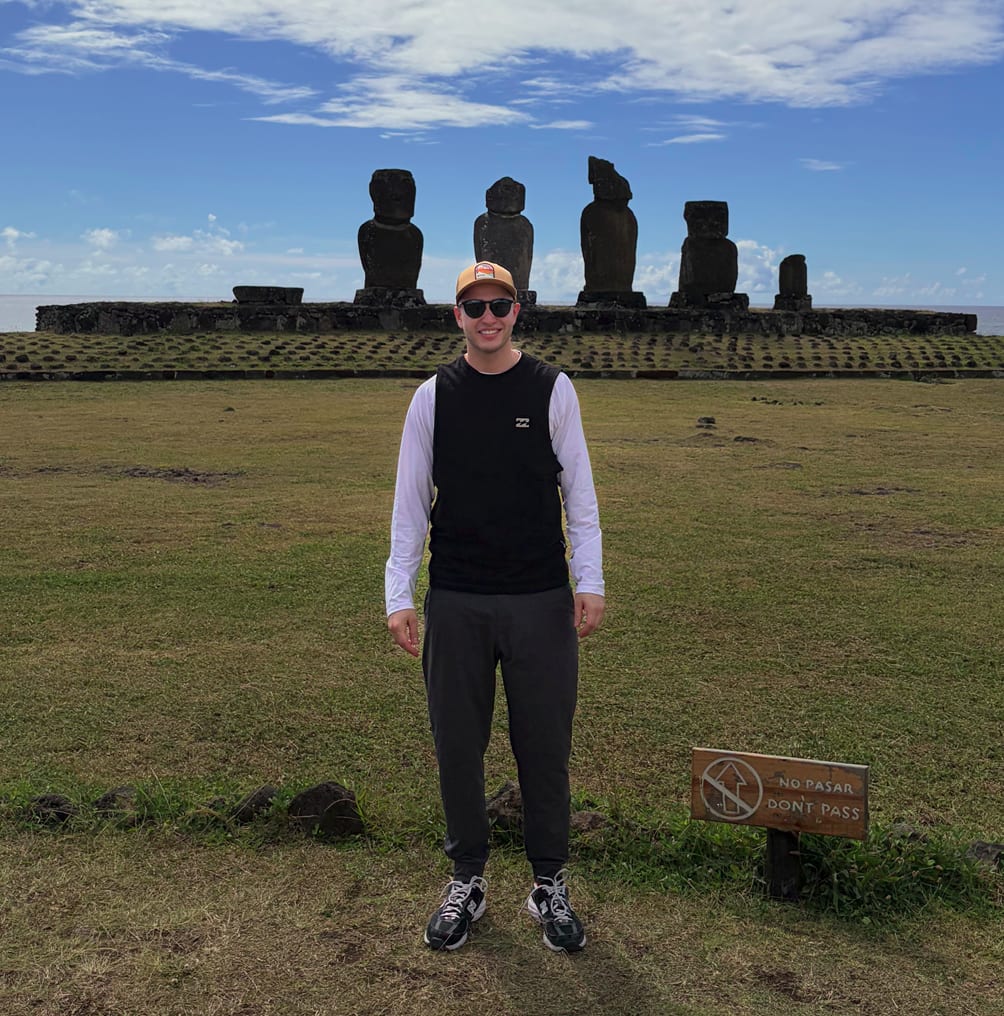
Tahai is one of my favourite places on the island because it is extremely easy to reach from the town, literally a 5 minute walk, and everyone in town comes here to see the sunset.
[carousel]
 Sunset at Tahai, an experience we repeated almost every day
 The complex is super large, and even though the moai here are in poor condition, their ruined state is somehow romantic
[/carousel]
 The moai at Tahai are not very well preserved
Rano Raraku
The Rano Raraku volcano is one of the most wonderful and extraordinary archaeological sites on the planet! In this magical place full of mystery, the moai were made, the giant statues that have made Easter Island famous worldwide.
 The Rano Raraku volcano as seen from above. It is composed of a unique type of rock on the island known as the Lapilli tuff, and became the quarry where almost all of the 1000 moai were sculpted.

The enormous figures and the quarries of the volcano surpass any expectation and personally I was speechless when contemplating this wonder of humanity.
[carousel]
 The body of many moais is buried under sediment
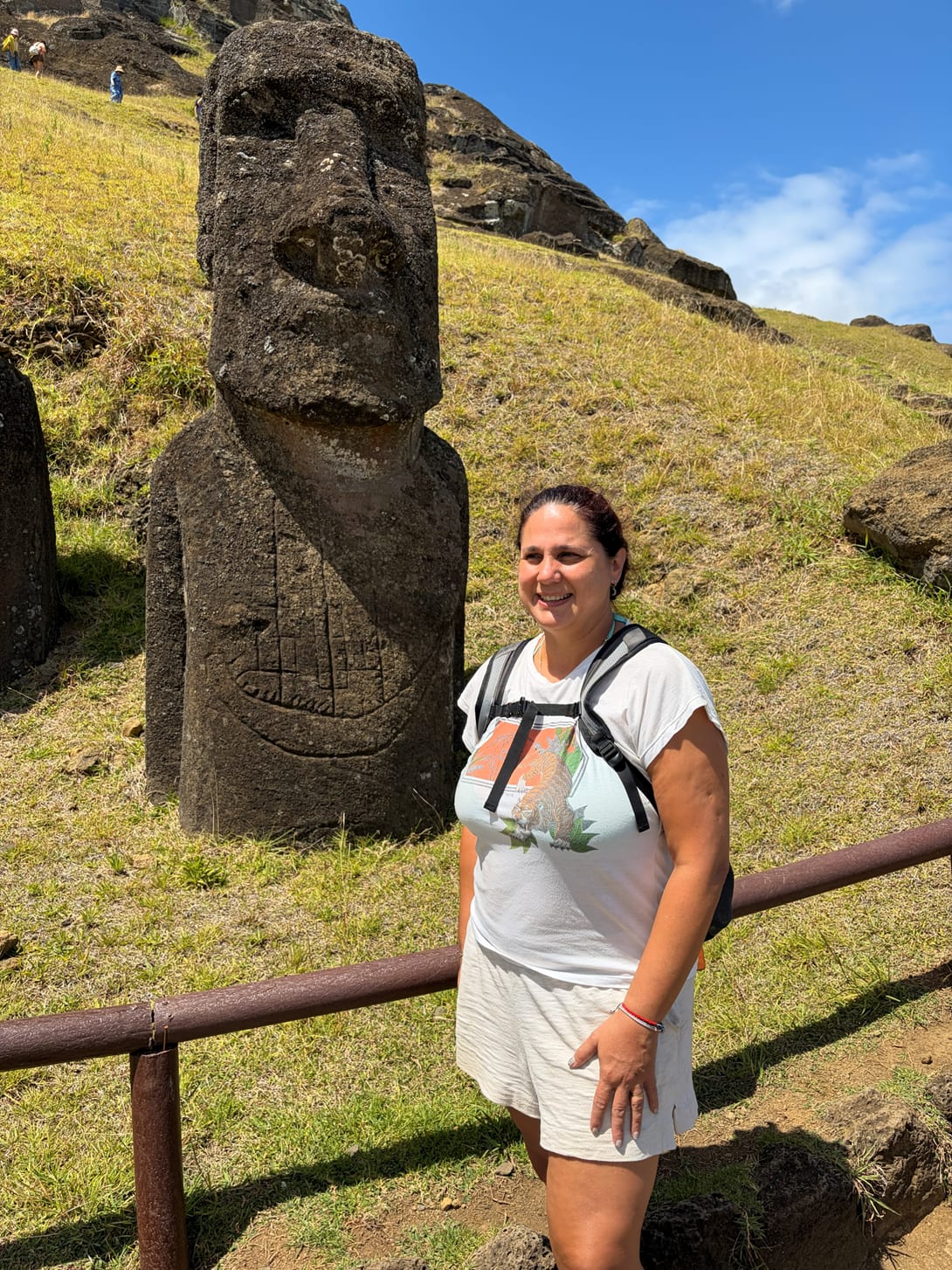 The islanders recorded their first view of the European ships in this moai
[/carousel]
Honestly, pictures don’t make justice to this place. There are dozens moais of various shapes and sizes, some with very refined and masterful features, some monumental in size, some of them half buried, others standing proud, others half-done.
 The black dots under the volcano are actually all moais!
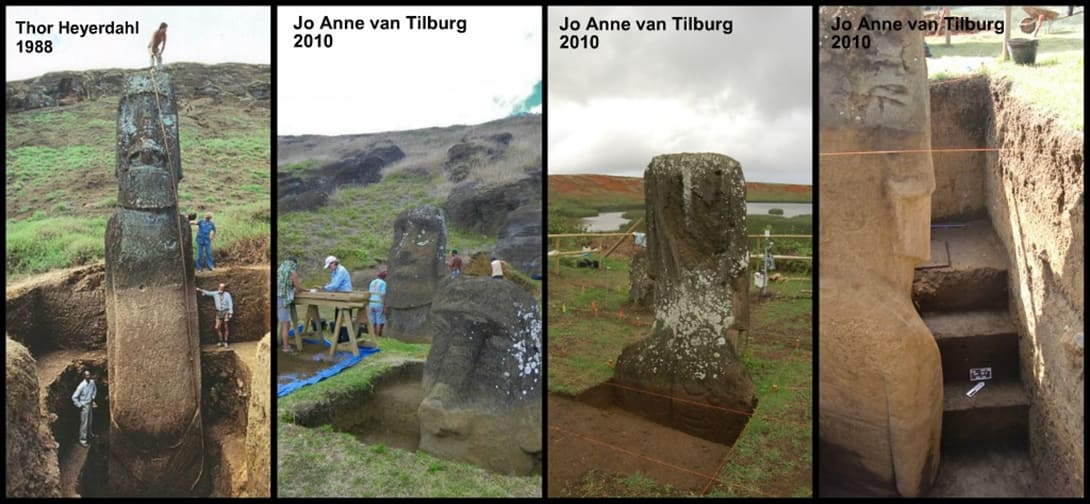 Images of different excavations that took place here
Ahu Tongariki
Also solid in my top-3 highlights of the trips is Ahu Tongariki, the largest Ahu on Easter Island featuring 15 moai, the largest one weighting 86 tonnes, the heaviest ever to be erected on the island.

Ahu Tongariki is the largest and most important megalithic monument in all of Polynesia. When European first arrived, the moais were no longer standing due to conflict between clans, and a tsunami in 1960 scattered them inland. Restoration was carried out in 1988 with the aid of a Japanese company.


We visited this site twice, since we booked a sunrise tour especially for our last day in the island. Really worth the early start!


 Ahu Tongariki after the 1960 tsunami
 Restoration of Ahu Tongariki
Next to Ahu Tongariki, we can find the the Traveling Moai, which was shipped to Japan in 1982 for an exhibition in Osaka; and was used in 1986 to carry out experiments as to how the moais were transported.
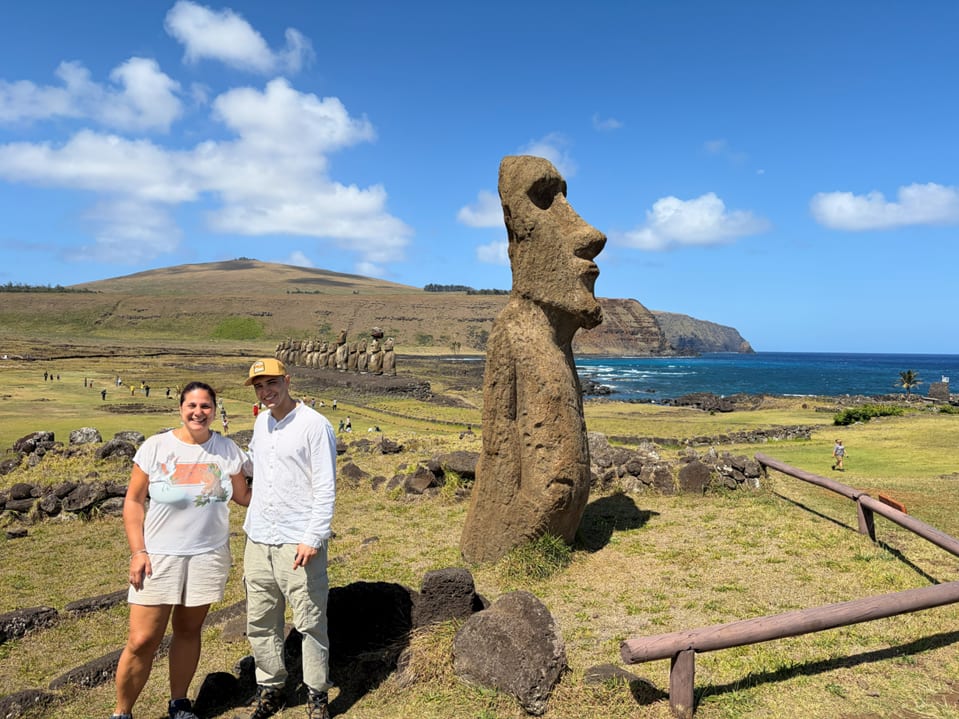 The traveling moai
 Experiments about moain transportation, 1986
Ahu a Kivi (Ahu A Tiu)
This is a sacred region in the island, featuring seven identical moai located in the interior of the island rather. These are the only moai in the island that look towards the sea.
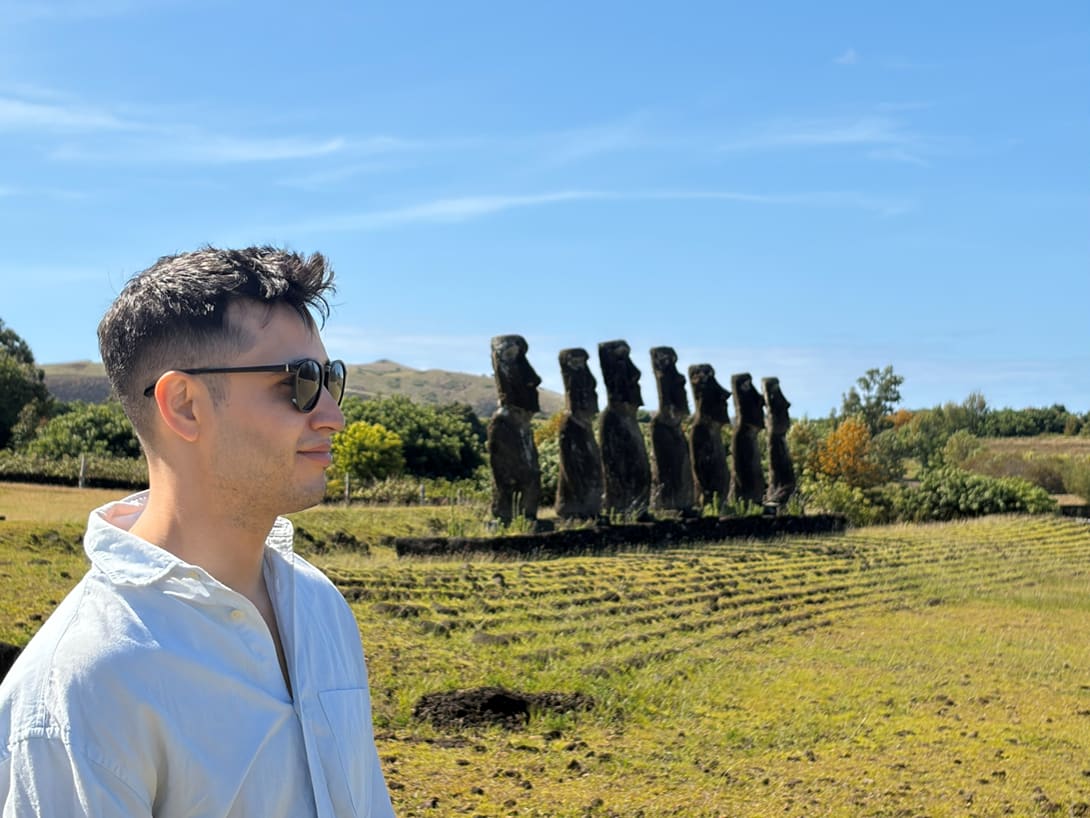
According to oral tradition, the priest of King Hotu Matu had a dream in which the king’s soul flew through the ocean, saw Rapa Nui island, and sent scouts sailing the sea to locate the island. Seven of these scouts stayed in the island, waiting for the king. These are the seven status: the first seven scouts.
 These were one of the first maois to be restored in the island in 1960
Orongo Ceremonial Village
Between the 18 and 19th Centuries, Orongo was the centre of the birdman cult, whose defining ritual was an annual race to bring the first manutara egg back undamaged from the nearby Monu Nui to Orongo. The ritual defined who would be the spiritual leader of the island for the next year.
[carousel]
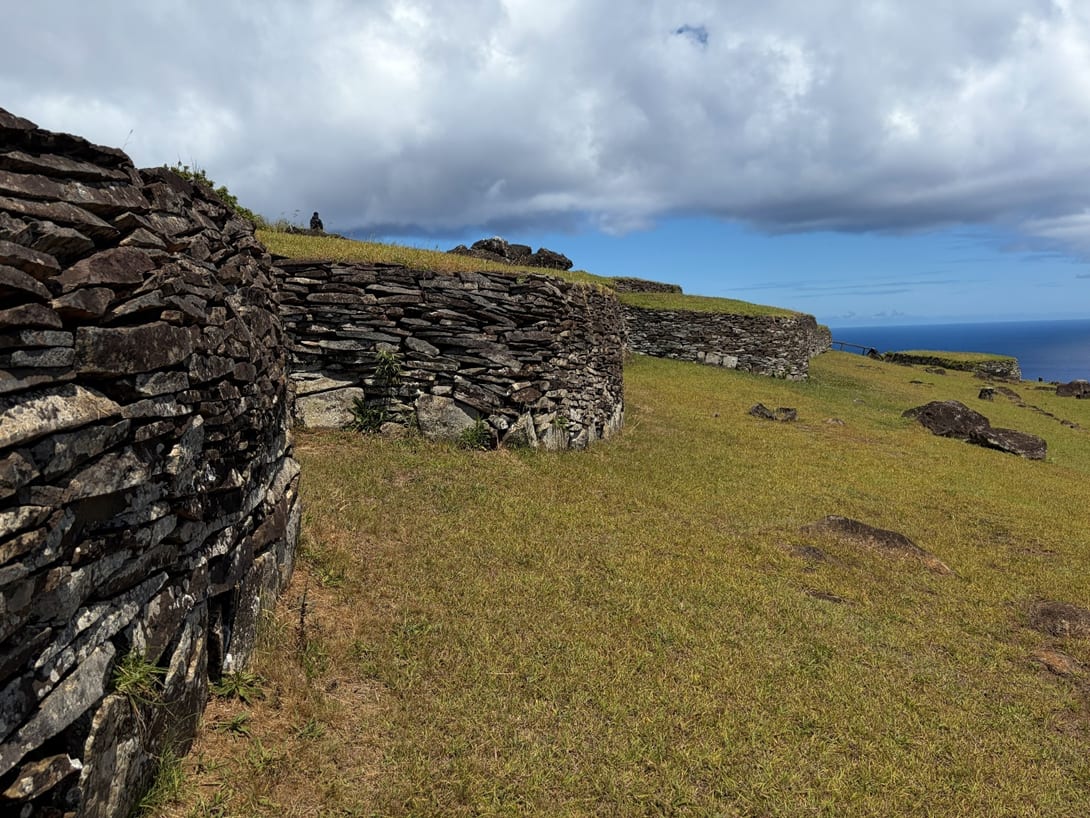 Terraced buildings at Orongo
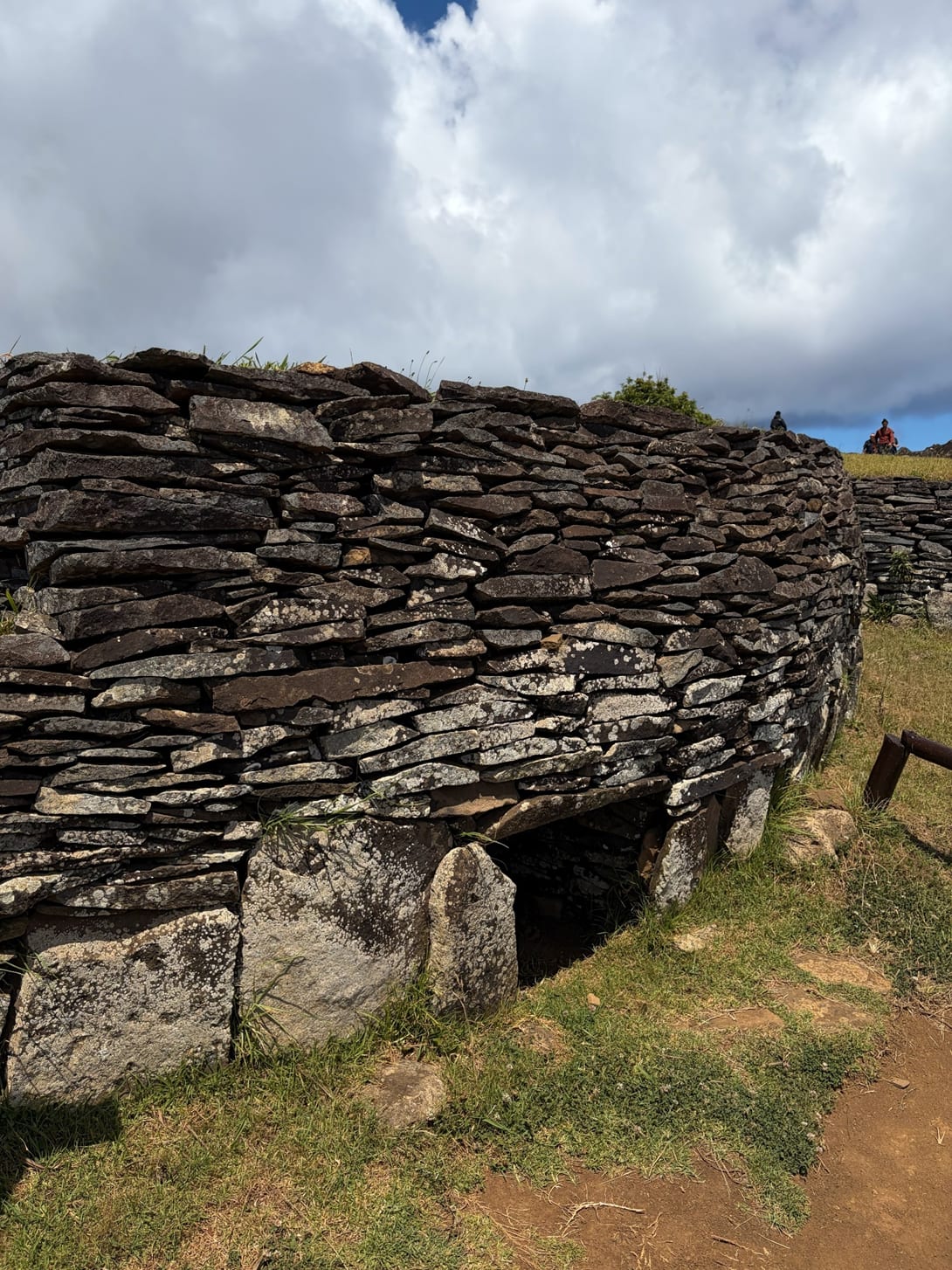 closeup to the entry of one of the buildings. People had to crawl in
[/carousel]
The dangerous race often had dead participants, since it involved going down the 300m cliff, swimming to the motu (sharks involved), picking the egg, and coming back.
 The race consisted of climbing down the cliff, swimming to the small motu (show in the picture), picking the first egg of the manatura bird, and coming back.
Today, a visit to Orongo involves driving up Rano Kau volcano and walking around the caldera where the traditional stone structures have been restored.
It is fascinating to me how this society found a way to balance power and leadership by setting up a contest between champions rather than outright war.
Rano Kau
Solidly in my top-3 highlights of this trip is the mesmerizing crater of the extinct volcano Rano Kau. The crater is 1.5 km wide and it is filled with a lagoon of a funny, silvery color ; as well as foliage of all shades of green.
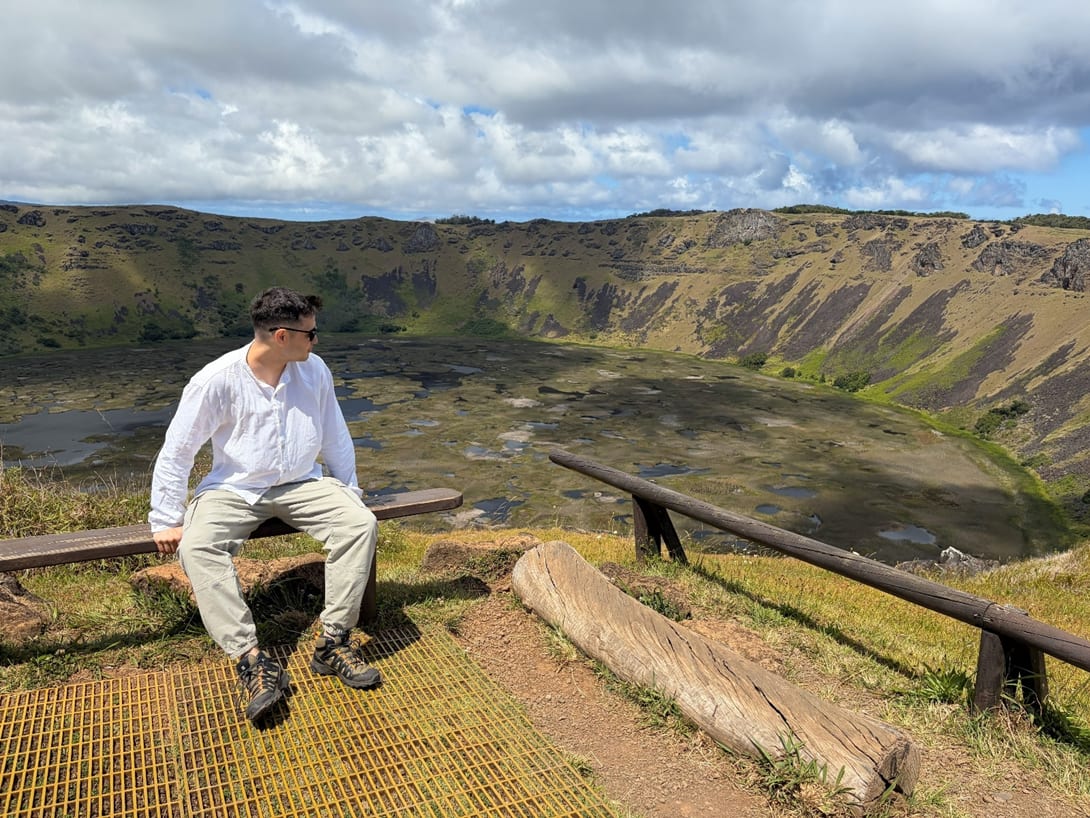 There is a public viewpoint outside the national park checkpoint, and there are more viewpoints inside Orongo village. Going down is not allowed.
 Zoomed in picture of the crater lake ecosystem
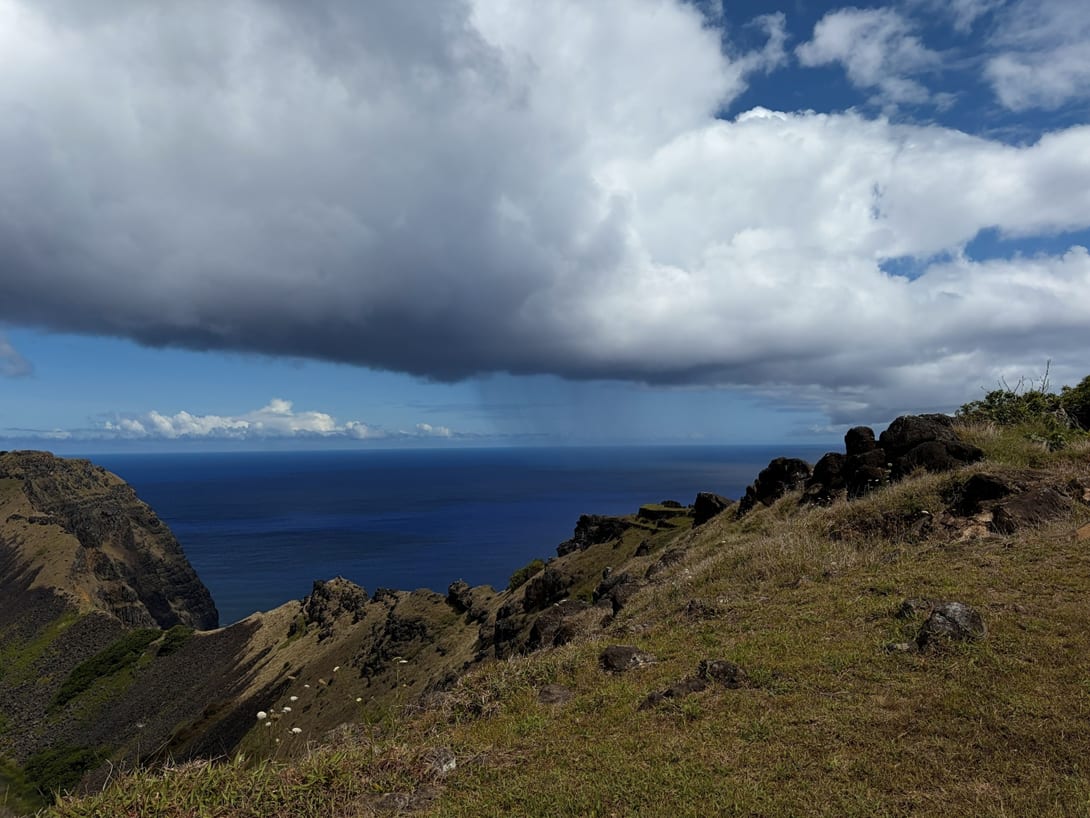 Sea view from the crater viewpoint. Can you see the rain falling at the distance?
Anakena Beach & Ahu Nau Nau
Anakena is the main beach of the island, and it seriously exceeded my expectations. White sand beach, loads of palm trees, crystal clear water, three nice restaurants, and plenty of room for hundreds of tourists if needed.
[carousel]
 Anakena from a nearby hill
 Path leading to the beach from the parking lot
[/carousel]
To top it up, five of the best preserved moais in the island are right there at a short walk distance: Ahu Ature Hoa (also known as Ahu Nau Nau)
[carousel]
 Ahu Nau Nau
 Can you make out the tattoos in their backs?
[/carousel]
When the statues were knocked down during the clashes between the various clans of the island, they were left buried in the sand on the beach, which allowed them to be more protected from erosion than the others.

The restoration work carried out between 1978 and 1980 by the team led by the Rapanui archaeologist Sergio Rapu
 An original moai eye was found here during excavations
Ovahe Beach
I wish we had had more time to spend an afternoon at little, hidden Ovahe Beach. The road is poorly maintained, and we were afraid of driving here on our own.
The beach lies under a tall cliff, it’s considerably less crowded than Anakena and the water was perfect.
[carousel]
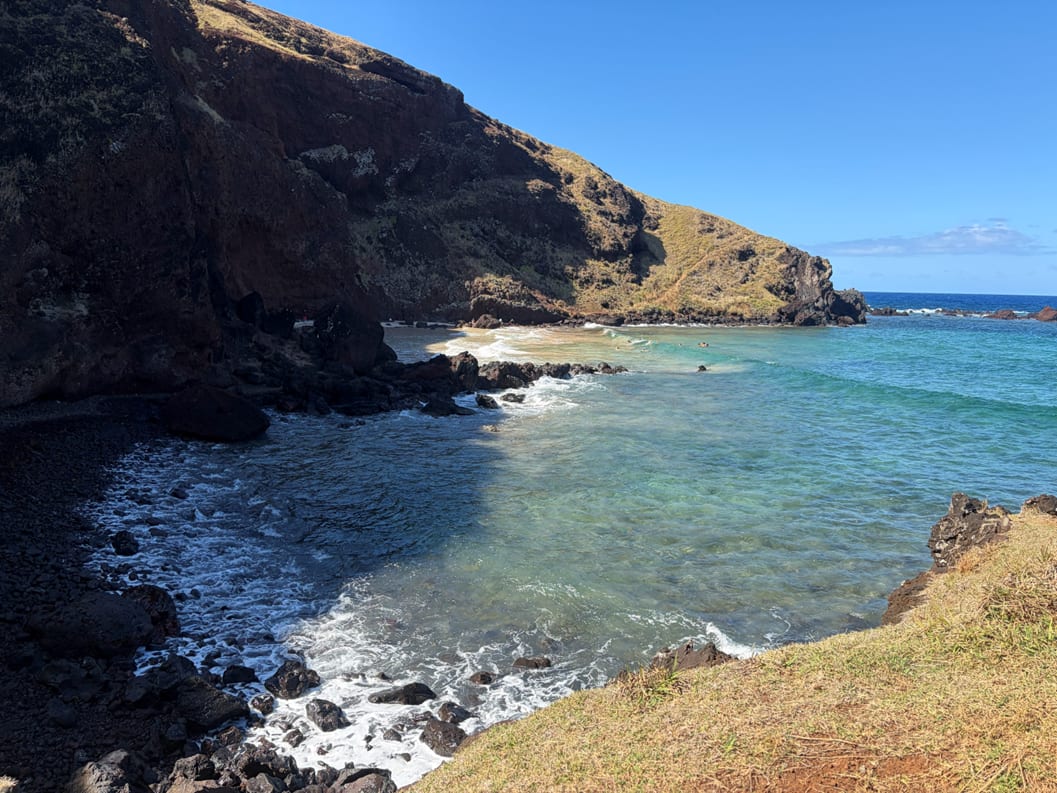 Ovahe beach is the sandy portion that can be seen distantly in this picture
 Bathing
[/carousel]
Scuba Diving
The highlight of diving in Easter Island was the exceptional visibility, usually 30-60 meters, thanks to the crystal clear waters. One can see huge formations and structures of coral, feel a sense of openness and immensity, and observe the overall marine landscape here.

On the down side, the marine life is a little scarce. The typical small reef fish are present, but in significantly fewer numbers. I did see a number of large puffers that were so good!
Tip: I was rather upset that the tour agency did not take me beyond the bay. They claimed they need at least 4 advanced divers to go outside the bay. I wish I had waited last minute to see which agency had enough people.
 The underwater moai. Can you see the moai?
 closeup of a puffer fish
Secondary sites
Ahu Huri a Urenga
This lone moai is located inline, in an agricultural settlement zone. It has the peculiarity of being the only moai with four hands.

Puna Pau
Worth a small detour, Puuna Pau is the quarry where the red topknots (Pukao) of the moai were extracted from. You can still see a number of huge Pukao in the floor.

Vaihu
Worth a quick stop, Vaihu is an archaological site that works as an open air museum with restored traditional houses, shelter for crops and other ruins.
[carousel]
 Traditional boat-shaped houses
 Waves breaking at the rocky shore
[/carousel]
Waves breaking at the rocky shore
[/carousel]
Driving around the island
A very interesting experience was to drive around the island, seeing lone toppled moais in the south coast, dramatic coastal views, loads of cows and wild horses.
[carousel]
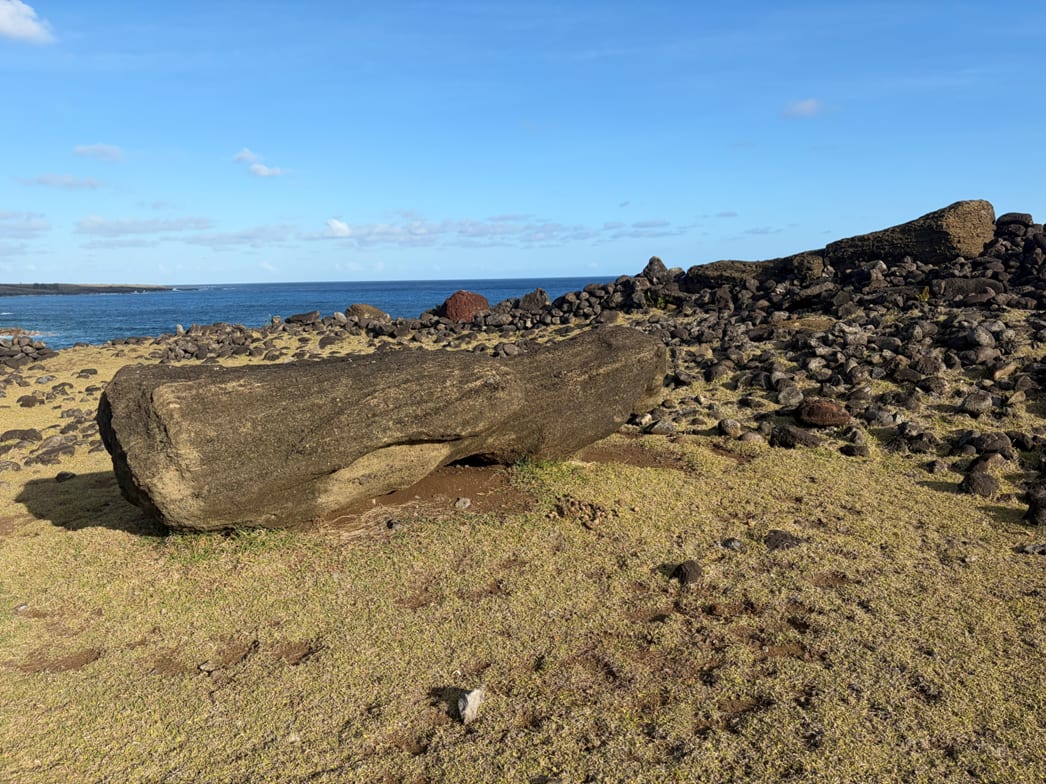 Yet another fallen moai
 It’s not every day that you see cows bathing in the sea
[/carousel]
Papa Vaka
A minor archaeological site where you can see petroglyphs.

Vinapu
Another archaeological site, worth a short detour. Here you can see an imposing ahu with many fallen moai. Fallen moai are an evocative sight to me, they convey certain melancholy for what was lost.
Most moais were toppled during civil wars, before the Europeans first arrived.

Te Pito Kura
I really liked this site, which felt both dramatic and romantic at once. A lone, fallen moai lies in a remote coast; its Pukao lying right in front of him, and the wakes of the sea breaking behind him.

Caves
Many tour guides try to sell cave tours, which I was not very keen on doing but ended up going anyways, since the guide decided randomly to take us.
If you are into large underground caves, and gardens growing within caves, this may be a good option to include in your schedule. Personally, I would be skipped it.

Practical tips
Hanga Roa Town
The town has a number of very good restaurants and provides all basic services you would expect to find in the continent: bakeries, coffee shops, ATMs, grocery stores. This is no minor feat, considering how remote this place is.
I would not call the town pretty, it is a little rough around the edges, but I was pleasantly surprised at how good the infrastructure and restaurants were compared to e.g. French Polynesia.
 Drinking a jar of Sangria in Hanga Roa Bay
I enjoyed all my meals so much, mainly because you can order freshly caught tuna pretty much everywhere, and it’s invariably delicious.
[carousel]
 Expect to pay 25000 CLP at a casual restaurant and 40000 CLP at a fancy one
 Anakena Beach has three good restaurants, but beware they are a little more expensive than in Hanga Roa.
[/carousel]
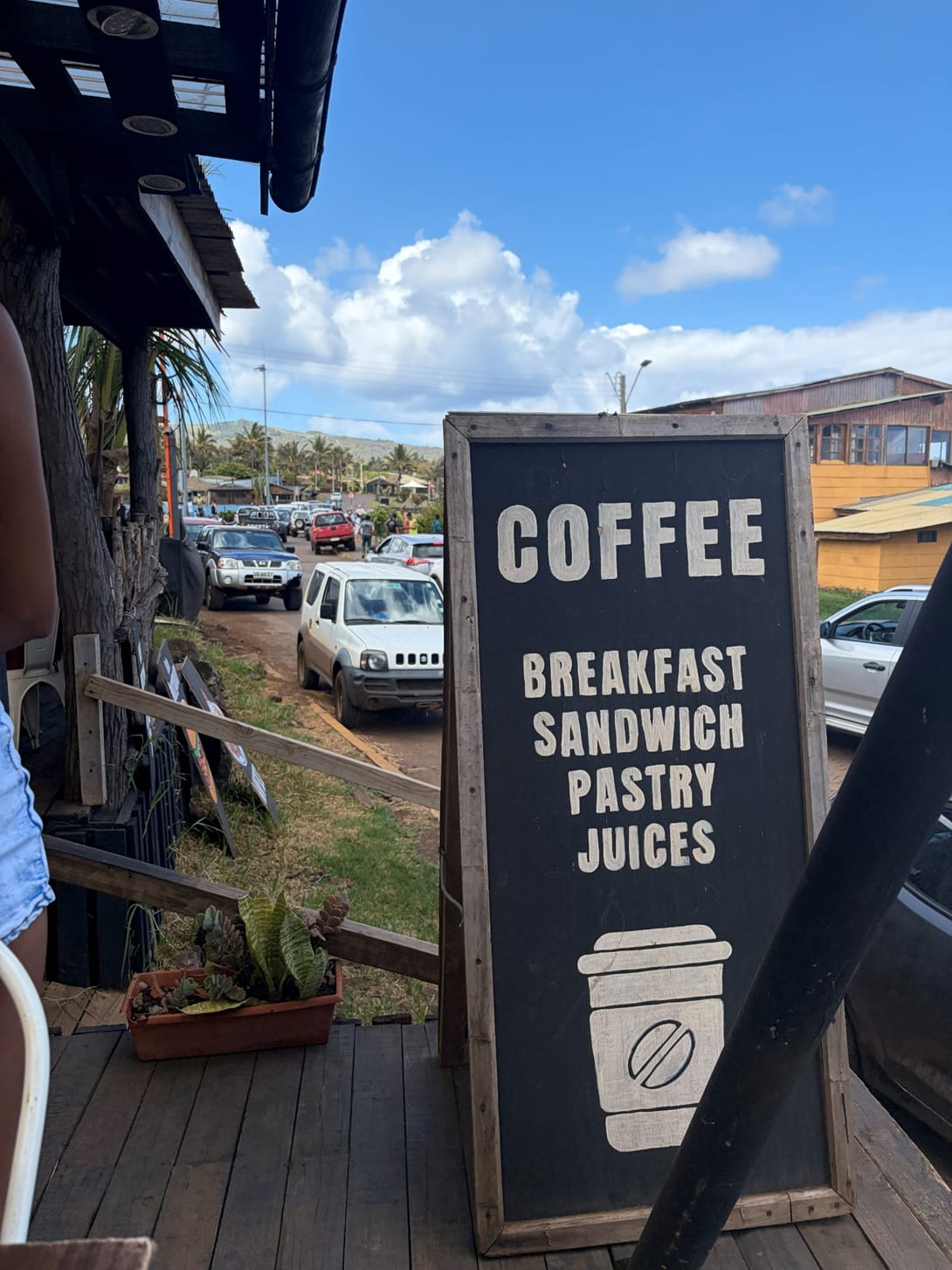 I’d buy every morning at flat white at this specialty coffee shop
Guide requirement
After COVID, the National Park implemented a new policy: it is compulsory to be accompanied by a local guide in order to visit any site administered by the park. This includes most of the main attractions: Tongariki, Rano Raraku, Orongo, etc.
I was extremely furious at this policy. The local guides, which are listed in the national park website, have zero qualifications. Literally anyone living in the island qualifies as “local guide”. This constrains a lot your freedom to roam the archaeological sites, and gets you stuck either with a private guide breathing in your neck or with a bunch of noisy people on a group tour.
The excuse is to preserve the sites, but I have seen groups of 25 Chinese people with a single guide who is incapable of watching over them. The truth is that this policy is just intended to force tourists to spend money on islanders. My private guide was drunk on the first day of the tour, and when I fact-checked many of his claims as he guided us, I realised he was just making things up.
That said, it is what it is, so you need to arrange for a guide to escort you around sensitive sites. I suggest a private guide, which can cost $500 to $1000 to cover all main sites in roughly 3 days. Group tours are cheaper, but you also get stuck in a mini bus with ~20 people, and you need to explore the moai with a crowd of people snapping pictures which quickly destroys the atmosphere.
Our guide was incompetent, but at least we were usually alone at the sites or joined by very few other visitors.
Beware: All guides and agencies will offer “full day tours” that actually last just 6 hours, and a half-day tour lasts 3 hours. With 14 hours of daylight, even if you book full day tours, you’ll have plenty of extra time to spare.
Expenses
Taking into account how remote the island is, I was expecting even higher prices. The island is more expensive than the mainland, but it definitely could be worse.
| Concept | Cost |
|---|---|
| Round trip flight SCL <-> IPC | USD 300 |
| 2 Bedroom cottage for 4 nights, seafront | USD 600 |
| National Park ticket | USD 100 |
| Private guide for 2, 3 days + sunrise in Tongariki | USD 500 |
| Rental car for 24 hs | CLP 50000 |
| Dinner: Tuna at a Fancy Restaurant + Drink | CLP 35000 |
| Dinner: Inexpensive restaurant + Drink | CLP 25000 |
| Scuba diving - Single tank dive | CLP 50000 |
| Flat White at a Specialty Coffee | CLP 4700 |
You can pay everything by card, even tips (10%) at restaurants. There are two ATMs, and we used one successfully. People will charge you in CLP.
Final Thoughts
My trip to Rapa Nui surpassed all my expectations. The moai were far more monumental and magical than I had imagined, and their sheer number left me in awe. I encountered wild, untamed nature both atop the Rano Kau volcano and beneath the waves while scuba diving along the vast coral reef.
I’m grateful to have fulfilled my dream of visiting this remote, almost mythical place, and even more so to have shared the experience with my wonderful friend Nadia. Even though I will not come back, since I’ve had my share of Moais for a lifetime, I will cherish the memory of the few days I spent exploring this remote corner of the world.
The following sections are suitable for history nerds only!
Appendix: History of Rapa Nui
To better enjoy and understand a trip to Rapa Nui, I strongly advise spending just a little time understanding the distinct stages in the island culture.
Stage 1: First Settlement (800-1200 CE)
Polynesian voyagers settled Rapa Nui after crossing ~2000km of open ocean, bringing plants and animals typical of migration waves (sweet potato, chickens). They arrived between 800 and 1200 CE, we cannot place a more concrete date, from the Society Islands or the Marquesas (now French Polynesia)
Take a second to take this in, because it blows my mind. The Pacific ocean is a HUGE blank void, the…zre is no land near Easter Island for thousands of kilometres. The Polynesian conducted systematic, multi-generational exploration projects over centuries. They mastered celestial navigation and sailed on double-hulled canoes, conquering the most remote islands on Earth.

Stage 2: The Rise of the Moai Cult (1200-1700)
This is the golden age of Rapa Nui culture, when society became monument-focused, engineering-driven and stratified under powerful chiefs. The platforms (ahu), moai, topknots (pokai) all come from here.
Moai represented deified ancestors, guardian and sources of mana (spiritual power). The ahu platforms were both shrines and family power bases.
The society was structured into multiple clans across the island, each high high chiefs, priests and common laborers forming the workforce to built monument.
Estimates range widely, but possibly population peaked at 10000. About 1000 moai were carved.
Between 1500-1700 the moai construction slows, resources get stressed (deforestation, soil loss), and inter-clan rivalry intensifies. Most ahu are desacrated and many moai toppled.
 Moai Map
How the moais were moved:
Stage 3: Birdman Cult (1500-1866)
After the decline of moai building, Rapa Nui society shifted to the Birdman Cult (ca. 1500–1866), a new religious and political system centered on the god Makemake. Authority moved from ancestor worship and moai to a ritual competition that determined leadership each year.
The central event was the Tangata-Manu competition. Selected men, or Hopu, climbed the cliffs of Rano Kau, swam to the sacred islet of Motu Nui, and retrieved the first sooty tern egg of the season. The first to return with an intact egg granted his chief the title of Birdman and temporary rule over the island.
This system allowed the islanders to maintain social cohesion and spiritual order for centuries. It ended in the 19th century due to European missionary influence, epidemics, and slave raids, but left a lasting mark in Rapa Nui’s petroglyphs, ceremonial sites, and cultural memory.
Stage 4: Foreign disruption, collapse and revival
After the end of the Birdman cult in the late 1800s, Rapa Nui entered a period of foreign disruption and collapse. European contact brought disease, slave raids, and forced relocation, reducing the island’s population from thousands to barely over 100 survivors.
Missionaries suppressed traditional religion, converted the population, and outlawed ancestral practices. The island was increasingly controlled by foreign interests, with land privatized, people confined to limited areas, and their cultural autonomy diminished.
By the late 19th century, Rapa Nui was annexed by Chile (1888), beginning a new era of external governance. For decades the island functioned largely as a sheep ranch run by a foreign company while Rapa Nui people were restricted to Hanga Roa village. Over time, cultural revival movements improved rights.
Today, Rapa Nui is a Chilean territory with strong Indigenous identity, a balance of modern life and cultural revival. Moai restoration projects, archaeological protection, language preservation, and discussions over autonomy define the modern stage.
Stage 4 is the only one that is properly documented, since Europeans had written journals. Here are my favourite journal extracts:
Jacob Roggeveen Journal, 1722
This is the first European to disembark in EI.
April 6 The President submitting that we had now arrived within a distance of some two miles of the Sandy Island (..) we have seen smoke ascending in several places, from which it may reasonably be concluded that the aforementioned Island, although it may be shown to be sandy and barren, has nevertheless human inhabitants (…) During the forenoon Captain BOUMAN brought an Easter Islander on board, together with his craft, in which he had come off close to the Ship from the land; he was quite nude, without the slightest covering for that which modesty shrinks from revealing. This hapless creature seemed to be very glad to behold us, and showed the greatest wonder at the build of our Ship. (…) especially when the image of his own features was displayed before him in a mirror, seeing the which, he started suddenly back and then looked towards the back of the glass (..) A great many canoes came off to the ships: these people showed us at that time their great cupidity for every thing they saw; and were so daring that they took the seamen’s hats and caps from off their heads, and sprang overboard with the spoil1; for they are surpassingly good swimmers, as would seem from the great numbers of them who came swimming off from the shore to the ships. (…) It was incomprehensible to us how these people cook their food, for no one was able to perceive or find that they had any earthen pots, pans, or vessels. The only thing which appeared to us was that they scrape holes in the ground with their hands, and lay large and small flint pebbles in them (for we saw no other kinds of stone): then, having got dried litter from the fields and laid over the pebbles, they set fire to it and in a little time brought us a boiled fowl to eat very neatly wrapped round in a kind of rush, clean and hot.
James Cook’s Journal, 1774
James Cook was the third European to disembark at Rapa Nui. He wrote:
1774 March At eight o’clock in the morning, on the 11th, land was seen (…). I made no doubt that this was Davis’s Land, or Easter Island (…) by the help of our glass, discovered people, and some of those colossean statues or idols mentioned in the account of Roggewein’s voyage. (…) (..) a canoe, conducted by two men, came off to us. They brought with them a bunch of plantains, which they sent into the ship by a rope, and then they returned ashore. This gave us a good opinion of the islanders (…) As the master drew near the shore with the boat, one of the natives swam off to her, and insisted on coming a-board the ship, where he remained two nights and a day. (…) we observed that he called the numbers by the same names that they do at Otaheite; nevertheless his language was in a manner wholly unintelligible to all of us. (…) . We landed at the sandy beach, where some hundreds of the natives were assembled, and who were so impatient to see us, that many of them swam off to meet the boats. Not one of them had so much as a stick or weapon of any sort in their hands. After distributing a few trinkets amongst them, we made signs for something to eat, on which they brought down a few potatoes, plantains, and sugar canes, and exchanged them for nails, looking-glasses, and pieces of cloth. (…) We presently discovered that they were as expert thieves and as tricking in their exchanges, as any people we had yet met with. It was with some difficulty we could keep the hats on our heads; but hardly possible to keep any thing in our pockets, not even what themselves had sold us; for they would watch every opportunity to snatch it from us, so that we sometimes bought the same thing two or three times over, and after all did not get it. (…) Near the place where we landed, were some of those statues before mentioned, which I shall describe in another place. The country appeared barren and without wood; there were, nevertheless, several plantations of potatoes, plantains, and sugar-canes; we also saw some fowls, and found a well of brackish water. (…) They observed that this side of the island was full of those gigantic statues so often mentioned; some placed in groupes on platforms of masonry, others single, fixed only in the earth, and that not deep; and these latter are, in general, much larger than the others. (…) In all this excursion, as well as the one made the preceding day, only two or three shrubs were seen source: https://www.easterisland.travel/easter-island-facts-and-info/history/ship-logs-and-journals/james-cook-1774/
[carousel]
 Engraving (by James Heath, after an original drawing by Gaspard Duche de Vancy) depicts European explorers as they measure and record statues on the Polynesian island of Easter Island, 1786
 1776 - A View of the Monuments of Easter Island [Rapa Nui], oil on canvas, by William Hodges, ca 1776
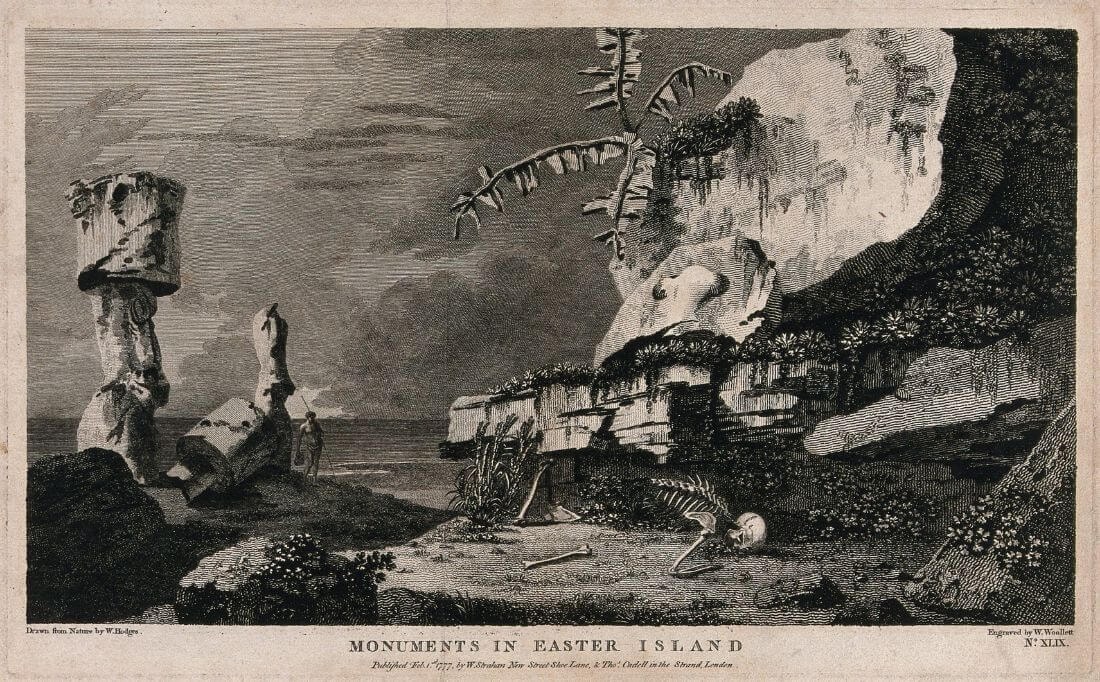 Engraving by William Woollett (1735–23 May 1785) after the original drawing by William Hodges RA (1744–1797)
[/carousel]
About a dozen Moai have been removed from the island and remain overseas, though some might be replicas or fragments. The most famous oversees moai is Hoa Hakananai’a, taken by the British and in 1868 and now in display in the British Museum in London.